ALAN ROBB – A TRUE GENTLEMAN OF COMRADES :

In my early days of running the men who took part in Comrades – and it was only men who were allowed to run officially back then – were called “gentlemen of the road” and the one person who has always epitomised this and still does is multiple winner, Alan Robb. Humble, quietly spoken and almost shy he is a real gentleman both on and off the road and in all the years I have been privileged to have known Alan I have never seen him any different and so it was a real honour to have been able to sit down and chat to him and to have found out things about him that I previously didn’t know.

DJ.     What was it that attracted you to running and to Comrades in particular and       when was this?

AR.     When I was in school I was a very good swimmer and in particular at backstroke but I started to get tired of the same old thing all the time and started to run cross country in school and discovered that I had a natural ability to run and so I gave up swimming and started running instead and I started winning cross country races. It wasn’t too long before I started seeing all the badges that people had on their tracksuits that they were getting at road races and I was attracted to those so I started running in road races and found that I was performing well there so that’s where my attention started to focus although I didn’t know too much about it.


DJ.      And Comrades? When did that first start to call you and tell me about that first run of yours?

AR      I was young. I ran my first Comrades when I was only 20 in 1974 and I knew absolutely nothing about it at all. My parents dropped me at the start and said they would see me at the finish and off they went and I was seconded by my 15 year old sister, Pam and her boyfriend, who were on the back of a “bakkie” driven by my cousin and they knew even less than I did so between us, we were completely clueless. Remember there were no official refreshment stations in those days so it was a case of fighting their way through the traffic. She sat on the back of the bakkie and her boyfriend got off the bakkie and ran alongside the bakkie and handed me a bottle with my drink – it was Coke – and then when I had had enough to drink he hopped back onto the bakkie alongside her as well. There was no planning as to where or how often I would get my drinks. I didn’t know the route or the hills or even the names of the hills or any of the landmarks so we knew nothing. I didn’t know where I was or how far I was from the start or how far I still had to go. I don’t remember that we had distance marker boards or anything like that. I knew nothing. I just ran and somehow I ended up finishing third in that first year just 4 minutes behind the winner Derek Preiss. It was then that I realised that I could possibly perform at Comrades. 1974 was an Up Run which was not all that enjoyable.


DJ.        Were you a lot better prepared the following year for your second run?

AR.      I thought I was but I realised shortly afterwards that I was probably just a little too arrogant and as badly or even worse off. In 1975 we had another Up Run because of the Comrades Golden Jubilee and I still didn’t know a lot about Comrades and that year I finished 5th after actually being in the lead at one stage. I took the lead around the top of Field’s Hill and led to around Harrison Flats and then “blew” and that was the better part of 30km out. I had two friends seconding me and I now thought I knew the route but I ended up slower than I ran when I had my sister seconding me in my first year because of the way I ran it.
DJ.     Then came your first win in 1976. You must surely have put in a lot of work in preparation for that and with a completely different approach?

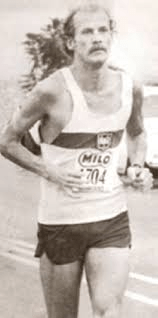
AR.    It was also my first Down Run and it’s no secret that I much prefer the Down Run and I put in a lot of speed work and hill work and changed my training a lot and I had a better knowledge of the route and my seconds were also by that time seconding me in all my races so they knew what they were doing and even a marshalling error in Westville didn’t stop me from winning and I had a very big lead and went on to win comfortably. The following year we were back for the Up Run in 1977 and I was able to win that again despite it being Up and then came what was probably my best ever in 1978 when I was the first person to go under 5:30 to win and I had been running at around 3 mins 45 secs per km to do that and very proud of that. It took quite a long time for that speed per km to be bettered.
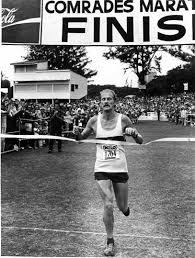
DJ.    You were on a serious roll and expected to make it four in a row in 1979 but that didn’t happen despite being the firm favourite to win you finished 5th.

AR.   Hindsight is the only exact science and had it been today I would probably not have run but I had had the flu a couple of weeks before and I thought I was completely over it but I was completely flat on race day and shouldn’t have run. Only a miracle would have got me home first that day and the gold medal was miracle enough. I made amends in 1980 by coming back for my fourth win on the Down Run that year though.


DJ.    If you look at the leading gold medal count I think you stand at the top of the list. How many do you have and who is behind you in the gold medal standings?

AR.    I’ve been fortunate to have been able to have won 12 gold medals over the years and that is more than anyone else so I am very proud of that. Bruce Fordyce is in second place on 11 Golds and Jackie Mekler and Shaun Meiklejohn in third place with 10 Gold medals each.


DJ.    And then in terms on total medals. You must be near the top of the list of total medals with your 42?

AR.    I am but there are chaps who have more than I have. Dave Rogers is in top spot on 45 and then a couple of other guys on 43 before you get to my 42 but quite honestly the number doesn’t really matter too much to me.


DJ.     I have asked others this question so I am going to ask you too. There have been 48 men winners of Comrades in the 90 Comrades we have had at this stage. If it were possible to have a “Super Comrades” of just those 48 winners who would you think would be in the top five and let’s assume that Alan Robb would be one of them, who would your other four be?

AR.    That’s always a very difficult question but I would have to go with Bruce at the top of my list and then the other three would be Wally Hayward, Jackie Mekler and Vladimir Kotov.


DJ.     You have run 42 Comrades in succession and that’s simply amazing. What is it that keep you going back year after year and how many more do you think you have in your legs? You have gone from being up there in the gold medals year after year to now being firmly amongst the bronze but still you go back. Why?

AR.     If I can keep finding the motivation to train I will keep running and the time doesn’t really matter too much at all. I have a few aches and pains in my knees these days and that might stop me from doing too many more but I love everything about the race. I love the tradition. I find it quite amusing when the newer runner looks at me as though I’m crazy when I greet Arthur Newton when I get to “Arthur’s Seat” every year. The history. The day. The crowds. The other runners. Everything about it and even if – when – I stop running I will go back every year for as long as I can.


DJ       And in those 42 years you have had your very own nutrition plan in Comrades that you have never changed since that very first one way back in 1974. Tell us about that.

AR      I have. I call it the 4Cs.   Coke, chocolate, chips or crisps and Castle Stout. The Coke and chocolate on the road and the chips and Stout at the finish as the recovery and it has always worked for me. I have always preferred Kit Kat as the chocolate and my preferred crisps flavour are cheese and onion for no reason other than I enjoy the taste.   The Castle Stout is like “mother’s milk” for me!


That’s Alan Robb. If you come across him he’s never too busy to talk to you and to offer some friendly advice. That’s just the way he is.
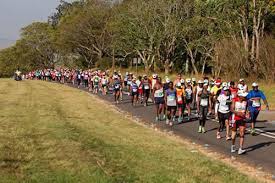
89 WONDERFUL KMS TO DURBAN

In May 1921 one man with a somewhat crazy idea saw his dream of a foot race from Pietermaritzburg to Durban become reality and at the end May every year we see the running of the Comrades Marathon. 90 of them are behind us now and we look ahead to 2025 to the 100th race, something that the man who came up with this crazy idea could not possibly have dreamt about.

That man in 1921 was Vic Clapham

It’s the road followed by the runners that I want to more or less look at. Comrades is run in alternate directions each year unless there’s a reason to change that and have two races in the same direction in successive years but this is not all that usual but as the original race was a “down run” I’ll look at that direction and as the next race we have in 2016 is a Down Run that’s another good reason to look at the Down Run in this chapter of The Marathon.

The “down run” starts outside the Pietermaritzburg City Hall which still claims to be the biggest red brick building in the southern hemisphere. Originally built in 1893, the Pietermaritzburg City Hall was badly damaged by fire in 1895 but rebuilt to its former glory in 1901.

The city hall organ is one of the largest pipe organs in the southern hemisphere. It has 3806 pipes ranging in size from 11 metres down to the thickness of a knitting needle.

If you look carefully at the photograph of the Pietermaritzburg City Hall you will see towards the left, the permanent structure that marks the start of the first Comrades in 1921.

Most people believe that the city got its name from two famous Voortrekker leaders, Piet Retief and Gerrit Maritz but there is another thinking that it was named after Piet Retief alone.  Retief’s middle name was Maurits and there is therefore some who think that the city started off as Pieter Maurits Burg – but who knows? However in 1938 the city fathers took the decision that the second part of the city’s name should honour Gert Maritz. Interestingly, history tells us that neither Retief nor Maritz ever actually got to the city. Retief killed by Dingane and Maritz died of an illness in the Estcourt area.

We leave Pietermaritzburg and make our way onto the “old road” which until the new highway was built, carried the traffic to Durban. Perhaps one of the most famous – or is that notorious – landmarks on the road must be “Polly Shortts” which – particularly on the Up Run – has been the undoing of many a runner. Polly Shortts is named after a farmer who lived nearby in years gone by, and whose help was often sought when, after heavy rain, the road up the hill became muddy and impassable and one can imagine that, when you consider almost 2km of an extremely steep hill in the days before tarred roads that Mr. Shortts’ tractor was needed.

Not too far after Polly Shortts we dip down to a little river and we find the Tumble Inn and in the days when Comrades started at 6am it wasn’t uncommon to see spectators having dragged double beds onto the route and would be watching the race as the runners went by, from the comfort of their beds, glass of champagne in hand. Naturally very warmly dressed as at that time on a winter’s morning it was very “fresh” in that part of the world.

Tumble Inn Teapot is situated on a Stud Farm in Ashburton. It’s a quaint little farmhouse offering a relaxed atmosphere to enjoy a timeout with the girls, a quick snack with hubby or a get together with the moms group! It sits at the bottom of a little hill that runners in the “old days” used to incorrectly call Mkondeni which is actually a suburb of Pietermaritzburg. The modern runner calls it “Little Polly’s” and again, on the Up Run, not a very pleasant little climb.

Nothing much to see as we climb up through suburbs to reach the N3 as it’s still dark on the Down Run and to the turnoff to the Lion Park and apart from the game that obviously includes lions you will find elephant and various antelope and certainly worth a visit.

But let’s move along the road back onto the Comrades route as we head to the highest point between Pietermaritzburg and Durban at Umlaas Road we get to the highest point on the route between Pietermaritzburg and Durban.

That’s right. You have been running for 20kms UPHILL to reach the highest point on the route of the DOWN RUN! You have been warned and it’s mainly in the dark so you can’t clearly see that it’s uphill.

After that it’s on through to Camperdown and

then to Cato Ridge and then onto the “old road” proper and the crowds start to gather to give you that much needed encouragement.

Along what is known as “Harrison Flats” and the turnoff to Nagel Dam and into the start of the Valley of 1000 Hills but for a better view of the Valley we need to travel a bit further along the route and to resist the temptation to stop on Comrades Day to look at the view which is really quite spectacular.

On from the turnoff to Nagel Dam a few kilometres further we reach the Entambeni School for the Disabled who have long been recipients of part of the charity from Comrades for many years. The children are out in numbers at the side of the road cheering the runners on race day.

Another couple of kilometres and we get to Inchanga. At the top more fantastic views this time towards the N3 down far below with scenic KZN in the background and ahead lies the little village of Drummond that is the official half way in Comrades and the point where the dreams of many runners are shattered when they are pulled off the road because they couldn’t make the cut off in the required time. Drummond comes alive on Comrades day as hundreds of spectators gather to see the runners and that dreadful gun the signals the half way cut off time.

But Drummond hasn’t always had its tarred roads for runners to use.

About a kilometre on the Durban side of Drummond, a couple of really important things.  Firstly a really nasty little climb out of Drummond that doesn’t really have a name that can be mentioned in polite circles and at the top of that is the famed “Arthur’s Seat” a seat carved out of the bank which is reputed to be the spot where the great Arthur Newton took a breather every year during his races in the 1920’s and runners are encouraged to stop and put a flower on the seat and greet the “spirit of the great man” with “Morning Arthur” if they want him to help them in the second half of the race. You can laugh about this if you wish but even the great Alan Robb greets Arthur Newton every year!   Are you prepared to take a chance and do the second half without Arthur’s help?  I certainly wouldn’t!

A few hundred metres further is possibly the best view of the breath taking Valley of a Thousand Hills and it’s also there that we find the Comrades Wall Of Honour that any runner who finishes the race can buy a plaque and have his or her name put up of the wall for all to see for all time.

The Valley of 1000 Hills is one of those few holiday destinations that has something for everyone. Unspoilt nature, wildlife, magnificent scenery, wining and dining, and warm country hospitality just a half an hour’s drive from the centre of Durban. The area is named after the thousands of hills which tumble down to the mighty Umgeni River, which flows from the Drakensberg Mountains to the Indian Ocean.

The old joke goes about sending mother in law for a one week holiday on each hill! Unkind and old but still used by many a downtrodden son in law.

Then on, into Botha’s Hill village, and another of the “big five hills” and some famous landmarks, probably the best known is the old Rob Roy Hotel that has now become a retirement home and one can but envy the views that the residents have with a different view over the Valley of 1000 Hills.

Not much further along the road is one of KZN’s most famous boys’ school, Kearsney College that excels in virtually every area. The classroom and the sports fields.

Comrades Day and it’s usual that the boys from Kearsney will be sitting and watching the runners go by and cheering for most of the day.

The beautiful entrance to Kearsney College seen in the autumn and incidentally, Kearsney College was founded in 1921, the year in which Comrades was first run.

Down the valley and into Hillcrest which about 30 years ago was no more than a village that has exploded into a good sized town offering everything from shopping to accommodation.

Leave Hillcrest and make your way through the leafy suburb of Winston Park and through into Kloof (heaven help you if you don’t pronounce it “Clue-oof” if you visit KZN). It is here in the Old Main Road that hundreds of spectators set up their areas to watch the race and cordon them off the day before Comrades to see the runners come through. The braai and beers forming as important a part of the day as do the runners.

After Kloof, it’s the drop down Field’s Hill into Pinetown and into the Josiah Gumede Road (formerly The Old Main Road) and well known to all Comrades runners since 1921.

Pinetown was a quiet little family type town until the early eighties but over recent years has boomed into a commercial hub. It has a rich history and as one travels through the centre of the town and you reach the Municipal Buildings one will find the stumps and bails on the commonage between the Pinetown Civic Centre and the Library alongside Old Main Road (now Josiah Gumede Road) to commemorate the founding of the Pinetown Cricket Club in 1878, when the first match was played there.   Please don’t stop there on Comrades day to look at the wickets as that will serve only to waste valuable time.

The wickets are some 20kms from the finish of Comrades on the Down Run and on your left hand side!   Interesting that when they were set up such cricketing greats as the late South African and Australian captains, Jackie McGlew and Richie Benaud were at the ceremony. There was also a small boy watching all this who grew up in Pinetown and who would many years later go on to run in Comrades Green Number 482 – but that’s another story altogether!

Leave Pinetown and it’s up and over Cowies Hill where at the top there is a fantastic view back over the town. On the Down Run it’s a tough climb but once you reach the top of Cowies Hill you know that most of the really hard work has been done and now it’s just “vasbyt”.

Cowies Hill has always been a very nice suburb of Pinetown with lovely houses and gardens. A sought after suburb.

Then it’s into Westville. Westville is an area near Durban and is some 15 km from Durban itself. Formerly an independent municipality governed by a Town Council, it is now part of the eThekwini Metropolitan Municipality, which also includes Durban. The town was laid out on the farm Westville (named in honour of Martin West, who was the first British lieutenant-governor of Natal) and it was formed in 1847. It developed from a settlement of German immigrants who arrived in 1848, and was proclaimed a borough in 1956.

When you get to the bottom of Cowies Hill on the Durban side the distance marker boards suddenly start to get invitingly low in terms of distance to go and it’s not long and suddenly you are into single figures as you reach 45th Cutting and you are now on the very outskirts of Durban and home is a mere 8kms away.

From 45th Cutting it’s a climb up from the traffic lights, over the top and down to what Durbanites call the Western Bypass and then it’s along a bit and the final little climb to the Tollgate Bridge.

Then it’s just 5kms home and it’s all downhill and flat running through the city centre to the finish at Kingsmead after you have spent the day running through some of the most beautiful parts of South Africa. A part of the country that thousands of runners who live the dream of a man who started this magical experience called The Comrades Marathon in 1921 have experienced.

It’s estimated some 300,000 runners have travelled this Old Road to Durban or from Durban over the years since 34 hardy souls set off to create history from outside the Pietermaritzburg City Hall on 24 May 1921.


BRUCE FORDYCE – KING OF THE COMRADES :

I can’t remember when I first met Bruce Fordyce. All I remember was that it was a very long time ago and I watched his career with amazement and admiration. The way he went about Comrades. The way he went about demolishing his opposition and the way in which he timed his race. There was never any panic. He was never in the lead at half way and that was always part of his plan. As part of the media I was always extremely frustrated because I simply couldn’t get to him before Comrades but that was also part of his plan. He gave away nothing and left us all guessing and as a result he had no unnecessary pressure on himself. He had enough anyway. I only had one clue and that was the year he came across to chat to me before the start in Pietermaritzburg and the clue was that he wasn’t going for a win that year although he said nothing and as a result I had the story ahead of most of the others in the media, so thank you for that Bruce.

This is the first time in all the years I have known him that I have had the opportunity to ask him these few questions. I hope you find them interesting. I have waited something like a quarter of a century to ask him some of these questions.

DJ.   The 31st of May 1981 and South Africa was “celebrating” 20 years of the “Republic” and the winner of Comrades on Monday, the 1st of June that year, a Wits student came across the finish line wearing a black armband in protest of the celebration. Not a very popular winner with many people but it wasn’t very long and Bruce Fordyce was everybody’s darling. Did you work hard to change that initial reaction or did it just happen because as far as I can remember you never came out apologising for that armband but yet the South African public embraced you completely and it didn’t take long.

BF.  I didn’t apologise for wearing the black armband and it actually took longer than you think because it wasn’t only the black armband that was my problem but also the fact that I had beaten the darling of Comrades, Alan Robb so the double whammy.  It even went on into 1982 which was a cold and wet year and I had one spectator shout at me “Where’s the black armband to keep you warm this year Fordyce?” but fortunately by the time I got to my third win in 1983 that was all behind me and the public seemed to have accepted me and it was time to go forward but there was really nothing I did, or could do to change that first perception. I’m just pleased it changed.


DJ.   You have often thanked your parents for the genes they gave you enabling you to run as you were able to do, but there was another part of your running and Comrades ability that stood you in good stead and that was your mental strength. I don’t ever remember seeing you flustered. You worked to a plan and that was it and if something did happen as it did in 1984 when you had to run like the wind to catch Bob de la Motte your incredible mind strength took over and you did what was required. I remember another time and I don’t remember the year when you were a little “ragged” and running alongside Hoseah Tjale about 25km out and he was strong but yet you beat him and that wasn’t your legs that did that but again that incredible mental strength. Did that come naturally or was it something that was part of your training?

 BF.  When things are important I have that mental strength. I would rather pay someone off the street to mow my lawn at home than have to do it myself because I hate it and I don’t have the mental strength to do that but when it came to Comrades that was different. I think the fact that I was sent to boarding school at a young age played a large part in that mental strength. I learnt endurance there to a large degree. The school where I was, was very old and had those old lead lined windows and each one in my dormitory was, for me, a week and I would tick one week off in my head before I could go home to my family so I picked up some endurance in how to “hang in when things were tough” there when I was quite young but the best advice I got was from Gordon Howie who said to me that I had to go to time trials and short races and learn to run in front and this was after I had already finished second and third in Comrades and I did that but I didn’t race long races other than those one or two crucial races a year. So I guess the mental strength was to a large degree something that I trained myself to do when things needed it.

DJ.     That handshake that became something of a trademark almost and that many thought was such a nice gesture from you as you went passed your opponents and into the lead.  Had you been a gladiator in ancient Roman times it wouldn’t have been a handshake, it would have been plunging your sword into your fallen foe to end it and I’ll never forget Mark Page surrendering to you by putting out his hand to you even before you extended your hand to him virtually saying “I’m done, take it”. When did you first decide that this was a great way to show your opposition exactly who was in charge at a crucial time.


BF.    Not entirely true.  The only person who could actually relate to you at that crucial time in the race was the person running alongside you and whilst you obviously wanted to beat the guy, the handshake was saying to him that whilst you were still strong it was also saying “I’m proud of you”.   Mark Page seemed to give up that day and he asked me who was behind me when I caught up to him on Polly’s.   I never saw the handshake as “I’m in charge” and I think the first time I did it was in 1986 with Bob de la Motte and it certainly wasn’t anything intentional at the time.   It was just one of those things that happened.


DJ.   Something I’ve wanted to ask you for the better part of 25 years. 1988 and eight    Comrades wins in a row and then came 1989 and an unofficial international 100km in Stellenbosch and you chose to run that rather than Comrades that year and what would undoubtedly have been your 9th successive win. Then in 1990 you came back and won again to make it your 9th win and that was it and the 10th was gone. I still to this day believe that you could have won both Stellenbosch and Comrades in 1989 and come back in 1990 and won Comrades – as you did in 1990 – and had your 10 in a row. With the benefit of hindsight, which is the only exact science, would you agree with me, even if it’s only a tiny bit?

BF.   I don’t think so. The first five of us were on a drip after the race and only Jean-Marc Belloq refused to go onto a drip but he was broken the day after the race. It was in my head that it was never going to happen. We South Africans had been going on about the fact that we were the best in the world and this was our chance to prove it and we took that chance against the best in the world over a recognised international distance but for me with that 100km in February, Comrades was never going to be on that year.

DJ.   In the 90 Comrades we’ve had up to the 2015 race there have been 48 different men’s winners. If it were possible, which it obviously isn’t, to take those 48 athletes at their peak and line them up for a “Super Comrades” who do you think would be the top five at the finish? Fordyce would have to be one of them, and probably the winner, but who do you think would be the other four and why?

BF.   If you look at Arthur Newton his times were slow but you can only ask him to be as   good as he could be at his time. If you look at Wally Hayward and you look at what he did at 80 you realise exactly what he did and of course Alan Robb provided it was a Down Run. Jackie Mekler if it was an Up Run. The fifth is a man who is someone who was probably a lot like me and that’s Hardy Ballington.  Four wins before the war and his fifth win after the war.

DJ.   Finally, you’re still putting a lot into running and you’re very involved in the         parkruns which are gaining in popularity all around the country and in fact around the world. It’s a fantastic concept. Tell us a little about it.

BF.   parkruns were started by my old Comrades second, Paul Sinton-Hewitt. He used to   run the Rockies Time Trial at Zoo Lake and he missed this when he emigrated to the UK because time trials don’t happen there and he started what he called “UK Time Trials” in Bushy Park in London in October 2004 and 13 people came and it continued like that for a long time until a second one started in Richmond Park and then another in Leeds and so it grew. I went to London Marathon in 2011 and was invited to run in the parkrun and decided to start in Johannesburg and we had our first one in Delta Park. We now have 325,000 parkrunners in over 70 different parkruns around South Africa and growing at a rate of about 5000 a week and we estimate that by the end of 2016 we should be close to 500,000 parkrunners in South Africa and worldwide we hope to be about 20 million in the next three or four years.


If you want to know more about parkruns you can find all the information on http://www.parkrun.co.za. You can register online and it doesn’t cost you anything at all and with over 70 of them around the country there’s bound to be one not too far from you and they are only 5kms and they are all on a Saturday morning and most of them at 8 o’clock.

There have been many brilliant Comrades runners over the years but King of the Comrades?   Probably fair to say that title belongs to just one person although Bruce might humbly say others deserve it.


BOB de la MOTTE – RUNAWAY COMRADE :

Whenever any conversation about the greatest Comrades runner never to win the World’s greatest Ultra starts, one name that always comes up is Bob de la Motte. The man who ran a 5:26 in the 1986 Comrades and finished in 2nd place and that time – even today – would have given him a pretty fair chance of a good win.

One of the strange things though, for me, is that of all the many top runners – and winners – I have met and come to know well over my years of involvement with this amazing race, Bob is not one of them. We have never actually met and by the time I became involved with the media, Bob was on the brink of emigrating to Australia so we have come to know each other through what I choose to call this “Blogbook” and through Twitter and by email.

Bob’s book “Runaway Comrade” which is a good read has his story in full, both during and post Comrades but I asked Bob to jot down a brief summary of the start of his Comrades story for me and here it is.
My dad had been the school mile and half-mile champ and my mother had been tennis singles champ three years in a row at our local tennis club. They had an athletic gift referred to as “stamina”, and fortuitously I inherited heaps of it winning the 800m at school and inter-school levels. Unfortunately I would painfully discover that Comrades required significantly more than my natural endowment of “stamina” over 800m. From a very early age I knew I could run long distances and despite my involvement in multiple sports (school colours for tennis, hockey and athletics) I simply loved running. As a young boy I discovered running to be totally liberating, blissfully simple and spiritual.

In 1981, aged 27, I made my Comrades debut after “jogging” a mere 844km in training over the four preceding months from a base of zero. My goal was a Comrades finisher’s medal as lifelong proof of my anticipated heroic achievement. I had been physically inactive for a decade whilst completing my BCom CA(SA) at Wits and then working abroad for three years in London and the USA. Let alone getting married, children, dealing with military conscription and pursuing a stimulating and challenging career with KPMG where 50 hour workweeks were the norm. Both my level of fitness and Comrades knowledge were woefully inept. On the other hand I had youth on my side bridled with blinding optimism and a “guarantee” from Dave “Smooch” Hodgskiss, the Chairman of my club (Varsity Kudus), that I would finish Comrades. He had already run nine silver medals en route to his Green number, so what was there for me to doubt?

On 1 June 1981 I limped across the Comrades finish line in Pietermaritzburg in 9:02 – exhausted beyond exhaustion. I was one of 1,332 novices in the field of 3,925 runners. A guy named Bruce Fordyce had crossed the line three and a half hours earlier to win his first Comrades. In my physically depleted universe I equated his athletic performance to landing on the moon. Simply beyond my comprehension.

In the ensuing weeks, once my body had thawed and my ego had been reflated, I joined SA’s running revolution of the 80’s as an enthusiastic participant. It was one of the luckiest things that ever happened to me.

I soon learned that the running trophies (or bragging rights) most sought after at the time seemed to consist of a sub-40 minute 10km, a sub-3 hr marathon, and the magical Comrades silver medal (sub-7.5hrs). Despite my torturous Comrades debut I now had something to aim for.

My first quantum leap in performance improvement was due to Hodgskiss. He introduced me to long distance training concepts like consistent daily runs, week after week, month after month, hard/easy sessions, 8km mid-week time trials, interval training, speedwork, Saturday cross country and Sunday LSD group runs. The latter being the social highlight of the week.

I managed to run almost every day, consistently logging 80km training weeks. By the end of 1981 the results were trending positively – 26.55 (8km), 33.32 (10km), 73.28 (21km) and 2:37.40 for the marathon. Intuitively I knew I had the potential to improve my marathon PB so I aimed for membership of the exclusive “sub-2:30” club – the next level of bragging rights. Fortuitously Mark Plaatjes got wind of my plans and gave me some more unsolicited, invaluable advice… “don’t run junk miles!”

I had no idea of the profound impact that his single bit of advice and enduing friendship would have. Within months I had shaved at least another minute off all my PB’s capped with a 2:26.01 at the 1982 Peninsula Marathon – barely one year after starting running from a zero base. Three months later I returned to the 1982 Comrades for an attempt at a silver medal and ran 6:04.12 for 16th place in my debut “down” run. Bearing in mind that the course was 91.3km in 1982, my time would have been a sub-6 in virtually every other down run despite my second half being 24 minutes slower than my first half. I had clearly faded in the second half but so had all the thousands of runners behind me. That unexpected result got me tantalisingly close to a previously undreamed of “top-10” finish, an even higher level of bragging rights. Then again it was like sitting at Everest Base Camp and looking at the summit, oh so close but still another 3000m of vertical climbing including a passage through the death zone. I knew there would be no short cuts to a “top-10” Comrades finish.

Fordyce had won his first down run in 5:34 – half an hour ahead of me. I had been running for barely 16 months while all 15 finishers ahead of me were seriously tough nuts – highly experienced Comrades runners hardened with tens of thousands of km’s already in their legs together with invaluable Comrades wisdom. Understandably my 1982 Comrades performance would have been seen by many as nothing other than a fluke or a flash in the pan, never to be repeated. I saw it differently. By running intuitively and without fear I had experienced my first glimpse of the pointy end of the Comrades and, despite a tough second half, it had been a profoundly more comfortable experience than my ill-prepared nine hour debut a year earlier. My consistent training and daily running since my debut had produced results. Regardless, I knew I still had to serve my Comrades apprenticeship – there was no magical elixir.

A broken ankle due to a windsurfing accident kept me out of the 1983 Comrades which, in hindsight, was probably a very lucky outcome for me. Following rehab I did not run a race further than 42km throughout the year and focussed on the shorter, faster events … and no junk miles. So when I lined up for the 1984 Comrades, hoping to crack a top-10 finish, I had accumulated some 10,000km of quality running since my 1982 Comrades outing, including a 2:20 (4th pos) at the 1984 Peninsula Marathon and a nifty 3:17 (2nd pos) for the “slow poison” 56km Milo Korkie at altitude. Although I was still improving overall distances my Comrades knowledge and experience remained seriously lacking. I had run the Comrades only twice –once in each direction. Fordyce had seven medals to his credit including five golds and three wins. This guy was already the General Eisenhower of Comrades. His cumulative running amounted to 42,125km (Lore of Running) – I had clocked up a lifetime 16,771km not even 40% of his training. Noakes did not include me in his selection of top-10 finishers. That was all about to change.

A few hours later I almost caused the upset of the decade when I stole the lead from Chris Reyneke shortly after passing halfway. Understandably Fordyce had his eye on elite runners like Bernie Rose, Willie Farrell and Brian Chamberlain. However, in order to eventually catch me at 45th Cutting he had to run the second half in 2:37.16 (equating to a 5:14 Comrades) and based on my research 32 years later he still retains the record for the fastest second half for the down run. He also broke Alan Robb’s record of 5:29.14.

My second place finish of 5:30 created history on a few fronts – the fastest losing time in Comrades history – the three runners who had previously broken 5:40 all won the race (Levick, Robb, Fordyce) I became the fourth sub 5:40 runner – Let alone breaking 5:40, let alone running a massive negative split of almost six minutes ( 2:48.14 / 2:42.45) I was desperately close to breaking 5:30 and still lost. I had been vanquished by Fordyce’s “turbo-charged” finish (3.30 per km for 44.9km).


That 5:30 Comrades performance suddenly made me realise I had serious potential as an ultra-runner – something I had never really anticipated. Simultaneously I had great potential in my stimulating professional career as a partner with KPMG. One of my personal lifegoals was a successful career and financial security. Fortunately I did not have to rely on my running talent to get me there. Running would always remain a sideshow for me. The interesting paradox was that Fordyce would be doing exactly the opposite, investing all his intellectual talent and athletic ability in pursuit of the Comrades as the first ever fulltime Comrades professional at the expense of his ten year tenure at Wits as a fulltime university student. One had to respect his courage and commitment. Inadvertently, as a consequence of my spirited 5:30 dice with Fordyce at the 1984 Comrades the media unexpectedly identified me as the one runner capable of beating him, causing much hype within the running community. Our casual friendship became very strained and tense. He posed no risk to my career at KPMG while I suddenly posed a significant threat to his prospective professional Comrades career – his future livelihood.

I knew I could be a top ultra-runner and I would give it a good crack as a “weekend warrior”. What was there to lose?

The cover photo for the book was taken at the 50km JSE ultra marathon in August 1985. Bob and others jostling for gold medals after the marathon mark and in hot pursuit of race leader, Sam Ndala. Gibeon Moshaba in white cap and Ben Choeu in black cap. Bob won in 2:50.45.

If you haven’t yet read Bob’s book “Runaway Comrade” do yourself a favour and get a copy. It’s a good read and proceeds go to benefit disadvantaged runners from Bob’s competitive era


CAROLINE WOSTMANN – ONE VERY FAST LADY RUNNER :

In 2015 Caroline Wostmann (pronounced Versed-man) shot to prominence when she became the first South African woman in 14 years to win Comrades and only the second South African woman to win Two Oceans and Comrades in the same year. She has an amazing story of a runner who started out as a very ordinary and average runner and became a “superstar” of Comrades.

I had never met Caroline prior to getting together for this chat and found a charming, down to earth and very together young lady who was easy to talk to and who had no airs and graces.

D.J.    How did it all start, your running career?

CW:    I battled to lose weight after the birth of my first baby. I was very unfit and      decided to attempt running as a means of weight loss. I started with a lap around my 800m block each morning and slowly built up from there.


DJ:      At what stage did you realise that you had that “special something” that would set you apart from the ordinary runner and take you into the category of the top runner where you are today?

CW:    I don’t think I ever thought that I had a “special something” but when I came 15th in 2012, I did think that if I trained harder I would be able to get into the top 10. I then overdid it and got a stress fracture and had to miss 2013 which definitely made me think I lacked the “special something” that the “elites” had!   Fortunately, I had a great doctor who referred me to biokineticists who helped me a great deal in getting strong enough to handle the hard training.


DJ:      In Comrades last year you seemed to be running to a time rather than against anybody else. Is that the way you ran Comrades and in fact Two Oceans last year?

CW:    Two Oceans was strange because I wasn’t trying to win it and I was just so comfortable and found myself in the lead and not in any discomfort at all and went on to a very comfortable win. In Comrades I was running to a time and my plan was to try to go into the lead around 20Kms from home but I was very surprised when I found myself alongside the leading ladies very early on and I was running with them but at a pace that was uncomfortably slow and so I moved away whilst I was able to do so and was comfortable with my pace right through to the finish.


 DJ:      What is your training like and do you race a lot?

CW:    I generally train twice a day with an early morning session and then late afternoon session and whilst I don’t race a lot I enjoy taking part in races but as training runs where I run slower than I would if I were racing. I enjoy the camaraderie of taking part in races but I am careful not to over race.


DJ:      Has winning Comrades changed you?

CW:    I don’t think it has. I’m still the same person I’ve always been with the same      priorities of family and if for any reason my training started to put strain on my family then I would put competitive running aside.


DJ:      Have people treated you differently since you won Comrades?

CW:    I find people are wanting to take a lot of “selfies” with me and I don’t mind that at all.           


DJ:      What are your future goals in running?

CW:    For now, my attention is still on Comrades and concentrating on that. I have run a 2:44 marathon and I am not sure that the marathon distance is where I want to focus my attention right now. I feel more comfortable at the longer distance.


DJ:      What do you think you can get to time-wise in Comrades? Under 6 hours on the Down Run?

CW:    I ran 6:51 in the last Down Run in 2014 so I have a long way to go to get to 6 hours on the Down and whilst I did 6:12 on the Up Run to win in 2015 they are very different races so we’ll have to wait and see. 2016 is going to be a very exciting Comrades with the field we expect this year.


DJ:      In your build-up to Comrades 2015 it must have been very difficult balancing three jobs that of mother to your two daughters, lecturer at Wits and runner at the level you are at. How did you manage it?

CW:    I couldn’t possibly have done it if it hadn’t been for the enormous support I had from my family. My husband was amazing and he would handle everything at home as far as the children were concerned. I would leave home at around 4am to go through to Wits so that I could get my early morning training session in, then it would be my lectures and then after that back to Pretoria for my afternoon training session before getting back home for our family time where we sat down as a family before the children went off to bed. During that family time there was no television or anything like that. It was quality family time. It was only after Comrades that we took the decision as a family that I would stop lecturing at Wits and only focus on running so that took a lot of pressure off us all.


DJ:      Tell me about your decision to change running clubs

CW:    Towards the end of 2015 I heard rumours that KPMG was launching a running club. Being a chartered accountant I was naturally interested to find out more about this as KPMG is one of the largest and best firms in my profession. I found out that KPMG had been developing athletics in South Africa for the last three years through a project at Vorentoe  School called the KPMG Vorentoe Running Academy. I was amazed to discover that after such a short period of time they had managed to win 38 medals in the SA athletic and cross country championships in each of the previous two years. This enabled me to realise the extent of talent we have in our country. Being passionate about education and athletics I was eager to become a part of this initiative and was thrilled to be afforded the opportunity by KPMG. I have no doubt that future Olympians and world champs will come from this project and hope that other corporates will follow in KPMG’s footsteps in developing our country’s potential.


 If anybody deserves success, it’s this lady. She has worked very hard to get to where she is now and we can only hope that it pays off for many years to come.

JACKIE MEKLER, ONE OF THE COMRADES GREATS :

Jackie Mekler has always been my Comrades hero and the fact that he was the winner for his 5th time the year I ran my 1st Comrades in 1968 gave me a special affinity that I know Jackie doesn’t even know about – or didn’t until he reads this blog. In those far off days little did I know that years later I would be able to count Jackie as a friend and that, for me was, and still is, an enormous honour.

Jackie was, to my mind one of the greatest ever Comrades runners and the dedication we saw from him in his preparation was unparalleled. I regard it as a privilege to have been able to have asked him a bit about his running career.

D.J.     What drew you to marathon and later to ultra marathon and Comrades in particular at a time when road running was not really regarded as a glamour sport?

J.M.     My mother died when I was nine, and I was sent to live in an orphanage where I hated the restrictions and the confinement of institutional living. Early one morning, aged thirteen while everyone else was still asleep, I slipped on a pair of takkies and went for a run on a nearby road. I enjoyed the exhilaration and freedom, imagining myself winning races in front of cheering crowds. As a schoolboy I watched many races over track, cross-country and marathons collecting autographs and getting to know the runners and clubs. Germiston Callies appeared to be best suited to my aspirations and I joined them at the age of 16. At 18 I ran my first marathon, and won my first marathon at 20, the same year that I ran my first Comrades.


D.J.     What was your philosophy on training for Comrades? We know that you did very long distances in your preparation.

J.M      By to-day’s standards my training appears nothing short of being haphazard. Throughout the seasons I raced over track, cross-country and marathons which I regarded as my speed work and my general training 5 min/km was an average club Comrades pace. Later when I was training alone I reduced this to 4.30min/km. 

When I was a printer’s apprentice, I used to run to and from work and once ran 57kms before work starting at 2:30am.  In a normal working week I ran up to 185 miles and which over a seven-year period gave me a weekly average of just under 160kms. I ran a lot of distance because I loved it and I enjoyed the loneliness especially running in forests and mountains. My mind’s constant repetitive playback of winning races played a big part in my approach to racing my Sunday training in later years often comprised of 80kms in the morning followed by a fast-ish 16kms in the afternoon. The whole trick is not to get too tired!

My longest race was the 100-miler from Bath to London in 1953 when I was 21, at a time when British athletes were not allowed to run more than 10 miles. I received a lot of encouragement from Arthur Newton, Fred Morrison and Wally Hayward.

The long, slow training I did with Wally and Fred under Newton’s watchful eye in 1953 did me no harm. I returned home the following year and ran with the best over 6 and 10 miles as well as winning several marathons as well as setting world track records for 30, 40, and 50 miles.

Jackie on a training run with Wally Hayward and Fred Morrison

 D.J.     There weren’t a lot of races around in those days, but did you do a lot of racing as part of your Comrades preparation?  If so how many races in the 5 months from January?

J.M.     In January I generally ran a 25 km race; February S.Tvl Marathon; March SA Marathon; April Pieter Korkie 38 miler; May Comrades


D.J.     Would you have liked to have been able to have run Comrades today given the professional era in which we find ourselves and what do you think you could have done because this is something that must have crossed your mind?

 J.M.     No I don’t think of it like that. When I started out, marathon running was very different to what it is today – the whole world has changed, and we now have the benefit of what we pioneers have struggled through. Just think that I ran for five years with undiagnosed anaemia, simply because medical science related to running was very scarce – the runners were so few that doctors had limited opportunity to gain experience from treating runners. I have no regrets of having run in my time frame.


D.J.     You were the first man to break 6 hours on the up run.  That must have been an amazing day. One of those days where everything just went right?

J.M.     Yes it was a very special day to have become the first Comrades runner to hear Maritzburg’s midday gun salute. It was the easiest of all my Comrades runs. I went on to win by over half-an-hour and better Wally Hayward’s record by 16 minutes. I had tracked Wally’s record all the way. I was 3.21 ahead at Pinetown; 4.55 ahead at Hillcrest; 7.40 ahead at Drummond, and 16.23 ahead at the finish.

Jackie with that familiar No. 9 to one side on his vest in Comrades

D.J.     Who was your biggest rival in Comrades?

J.M.     I can’t really say, because nobody beat me more than once, so I’ll have to block-book John Smith, Bernard Gomersall and Dave Bagshaw the three English runners who each beat me on different occasions.


D.J.     You split the English “attack” in 1962 when John Smith won and you were second and the remaining Englishmen in 3, 4 and 5. Was that one of your toughest Comrades?

J.M.     It was really a tough race. I ran like a novice going into the lead right from the start, was well clear of the field after six miles, and 8 minutes inside my record at Botha’s Hill. I received my first warning sign where the road winds down into Drummond at half way – I felt cold and shivery and called for hot tea. The cheers at Drummond told me that my 2hr 57min was 5 minutes inside the record and 6 minutes ahead of the English runners. The pace was telling on the way up Inchanga but there was nothing I could do about it but watch Smith come galloping past with 12 miles to go. It was a disappointing run for me because the English runners were well off my London-Brighton record and were not given a chance of winning. Smith retired a year later – he told me that he couldn’t be bothered to do all that kind of hard training!


 D.J.     Jackie Mekler aside, who do you think is the greatest Comrades runner of them all.

J.M.     I always try to avoid answering that question because of the “fivers”, Newton, Ballington, Hayward, Fordyce (and there could well be other contenders). Each lived in their own time frame and circumstances that I would find it difficult to separate them. I would give each 100% as athletes, as personalities, and for contribution to the Comrades.


D.J.     August 1954 in Vancouver and the Empire Games Marathon. One of the most dramatic marathons ever recorded Jim Peters came onto the track at the finish with a 17 minute lead and collapsed and didn’t finish. You eventually took the silver medal that day. What do you remember about it?

 J.M.     The staggering and collapse of world record holder Jim Peters with 200 yards to the finishing line will surely live as one of the most dramatic events in sporting history.

Jim Peters on the point of collapse

The British Empire and Commonwealth Games Marathon started in the Vancouver Stadium at 12.30 pm on a warm and windless summer’s afternoon – not ideal conditions for a marathon.

Added to this was a poorly organised event leading with the England team complaining that the course was too long. The feeding stations weren’t organised properly, runners could only have drinks at official feeding stations and team managers were not allowed on the course nor were runners told what was happening during the race.

Much of this confusion could be attributed to the “Miracle Mile”, the clash between the only two 4-minute milers in the world – Roger Bannister and John Landy – which event was being held just before the runners entered the stadium.  I was expecting a slow race and was prepared to bide my time at the beginning and anticipating to pick up a tiring field towards the end. I tried to keep track of the number of runners ahead of me, getting no information from officials or spectators. I was terribly disheartened thinking I was in 8th or 9th position. The only runner I passed was compatriot Jan Barnard struggling at 18 miles. Running up the last hill I could see a loudspeaker blaring in the distance at the final feeding station. By the time I had arrived the loudspeaker was gone. It was only after I appeared inside the stadium that I was told that I was lying second. Joe McGhee of Scotland won in 2.39.36 while I was 2nd in 2.40.57 and Barnard 3rd.

D.J.     I heard that you still go out and do short runs.  Is that correct and any idea of the total distance you have run in your lifetime?

J.M.     Yes these days I do my own brand of “fartlek” training – jogging interspersed with walking.    I have run more than 160,000 kms


D.J.     I know you still get to Comrades every year. It’s changed tremendously but does it still hold that special appeal for you?

J.M.     I do enjoy going down to Comrades each year meeting old friends and officials. Unfortunately these are becoming fewer and fewer. I also get satisfaction in helping handing out Green Numbers.

There you have it. Jackie Mekler’s story. One of the greatest Comrades runners ever?  In my book there is absolutely no debate about it and a true gentleman as well.


IS COMRADES TOUGH? YES IT ISN’T :

It’s January and time to start thinking seriously about running Comrades and how you intend to train to get there. Right?

It seems this is not the case at all and I know that this particular blog will probably land me in hot water with a lot of people many of whom will probably say “The silly old goat can only think of the old days” and perhaps that’s quite right but the “silly old goat” started 14 Comrades, finished 14 Comrades at a time when we didn’t have the luxury of a 12 hour time limit. We also didn’t have the luxury of a refreshment station every few Kms and had to rely on personal seconds who almost always were stuck in traffic jams and we went some fairly long distances without anything to drink. The “silly old goats” also didn’t have the fancy equipment available today and our shoes were the ordinary “takkie” or sandshoe used on tennis courts and we drank “corpse reviver” (described in other posts) and didn’t have the modern food supplements.

I’ve always felt that getting ready for Comrades and running it is pretty much like anything else one has to do in life from writing exams to preparing for a board meeting or running a company. Do it properly and prepare properly and when you get to the actual event itself, it’s not actually that bad.

I am not for one moment knocking the modern runner. Far from it as it was those inferior shoes being worn, added to a childhood back injury, that stopped my running altogether whilst I was training to run my 15th Comrades. I am however concerned that it appears that runners on average today, are slower than they were some 30 to 40 years ago and let me stress that I can’t talk for the winners or even the silver medalists.  I have never been one of those but I certainly know how to run a Bill Rowan so that puts me in the top half of the field.

The bulk of the tail-enders came in during the last hour when we had an 11 hour time limit and now that it’s 12 hours we still have that.

Don’t get me wrong. I’m not for a moment suggesting that the time limit should go back to 11 hours because it’s the 12 hour time limit that has resulted in more people striving to get that medal that is so very precious but it does seem that people have slowed down to finish in under 12 hours now rather than aim for the 11 hours they would have been required to do previously.

So what is the problem or is it even a problem at all?   What is it that’s causing this seemingly slower running?

Why is it that runners are doing a qualifying marathon of 42km in the required 5 hours (it used to be 4:30) but can’t get to the half way which is some 3km further than the marathon distance in the extra time of over an hour allotted to them by Comrades? Why is it, that they will run an ultra of, say, 50km in under 6 hours but 6 hours 15 is not enough time to do the 45km to half way in Comrades?

I was sitting down to write this and came across a quotation by Rich Simmonds, a professional speaker and self-styled “rule breaker and change maker” (I love those sorts of people) who said “Understand what everyone else is doing, but don’t do what everyone else is doing” and it occurred to me that what Rich says applies equally to Comrades.

I have seen the looks on the faces of those who can’t make the cut off times along the route and who fail to get to the finish in under the required 12 hours. That pain of not finishing Comrades stays with those folk until they are able to go back and beat it. I know one runner who talks equally of the one she didn’t finish as much as of the one she did. It must hurt not to be able to finish Comrades. It must hurt badly.

I can’t imagine how awful it must feel to have to get into one of the runners’ rescue busses and have a thick black line drawn through your race number.  The runner I know who had that happen, tried to describe it to me and it must have been horrible. To have that DNF alongside your name never goes away.

I believe that training methods and the mental approach are the main problems facing the modern runner.

Let me also, once again, say that I am not a coach and certainly not one of the official Comrades coaches but I am also not some sanctimonious “old timer” saying “we did it much better then” but I firmly believe that there are problems and that the problems are not the result of what happens on Comrades day. I think the problems are the result of the way runners prepare themselves in the five months from January to Comrades.

Week after week you’ll find the same runners in races “treating them as a training run”.  I honestly don’t believe that it’s possible to run a race as a training run because in the vast majority of instances you will run faster than you would a training run. Carry on doing that for months on end and get to the start of Comrades tired – or injured. 

I have runners saying to me all the time that at the beginning of May they are exhausted.  Good grief!  At the beginning of May runners should be feeling on top of the world and ready for the taper that is going to get them that unbelievably precious medal.

The other thing that has been cast aside now by so many ordinary runners is LSD.  The pure joy of getting together with a bunch of mates to go out on a long run on either Saturday or Sunday and “tea room hop” to get cold drinks is largely a thing of the past.

About now I can hear coaches saying “here he goes again” but the point is it works, and again I stress that I can’t talk for the top runners.  I heard of one runner prior to the 2015 Comrades who was running in a race almost every weekend.  When I was told about her, my reaction was that I thought, as a novice, she would be lucky to get home in under 11:45. I was wrong. She did 11:40!

The ordinary runner is busy with hill repeats and speed work during the week and races at the weekend.  Why?  I am the proud owner of 14 Comrades medals, all under 11 hours and two of them under 9 hours, and never once did I do hill repeats or speed work.

I had a road race called Comrades to run so I trained for that by running on the road. I had a long way to run on Comrades day so I built my leg strength and stamina by doing LSD – and it worked. As I became fitter my speeds automatically improved and that included hill speeds. Was I wrong?  My stats don’t say so.

My focus was Comrades so I studied the route and my times to be at various places. I never went near a gym. I know one runner who has a coach who puts her through rigorous gym sessions to the point where her legs are like jelly. Come Comrades day and it’s “an all fall down”. Her half marathon times are brilliant. Her Comrades times – very ordinary.

The runner who is capable of a best of 4 hours in a marathon, runs a race in 4:15 and says “I did it as a training run”.  That’s not a training run.  It’s just 15 minutes off your best!

If a top runner runs in a race as a “training run” he’ll do around 3 hours for a marathon when he’s actually capable of around 2:20. That’s a “training run”.

In the old days (here he goes again I hear the cry) we used to say that if you RAN IN A RACE you shouldn’t go near another race for 1 day for each mile of the race. In other words a marathon in old language is 26 miles so run a marathon but don’t do any other race of any distance for 26 days. That doesn’t mean don’t run for those 26 days after a marathon. It means don’t run IN ANOTHER RACE for 26 days after a marathon.

20 days for a 32km and 14 days between running a half marathon and any other race. That’s going to basically give you one race a month from January to Comrades.

It works and it’s not the ramblings of “a silly old goat”.

Remember when your mates tell you that I’m crazy what Rich Simmonds says.

“Understand what everyone else is doing, but don’t do what everyone else is doing”

One little bit of advice though. Don’t take advice from everyone in sight – and that includes me – because all that does is leads to confusion and you get to the start full of a dozen different opinions and – DISASTER!

Comrades isn’t tough. It’s the training to get that medal that’s tough.

Do that properly, both on and off the road, and Comrades is a great day. A fun day and boy does it feel good to get home ahead of your mates who ran in races every weekend and in two time trials a week!


IAN JARDINE – UNSEEING YET HE SAW :

I first met Ian Jardine at the beginning of May 1968 on an ill-fated training run from Pinetown to Pietermaritzburg which “the Old Man” used to organise every year at the beginning of May along the route and in the direction of Comrades in that particular year. I didn’t know him when we set off that morning, but I certainly did before that day ended.

On reflection I realise that I knew nothing about Comrades – and I mean nothing. We had started in Pinetown and by the top of Field’s Hill I was running alongside Manie Kuhn who had won the year before and was second the year before that. That’s how easy Comrades was! By the time we had done another 30Kms I was so far behind the rest of the group that I had to get into the car and be driven to where they were. I arrived and was told that “I.J. wants to see you”. In reality he had been blind for years and couldn’t see a thing but nonetheless I presented myself and he said to me “I see we have learnt about Comrades today”.

 As I came to know him over the years that followed I learnt that was his “stock phrase “I see” when in fact he could see nothing at all.

 Anyway, back to that awful run of mine and “Mr Jardine” (I never dared call him anything else as I was just 21 at the time) was very nice about it all, gave me some pointers, told me to try to run the rest of the way to Pietermartizburg, which I wasn’t able to do but to present myself the following Sunday morning at the top of Botha’s Hill to join them and in the few weeks left to Comrades, they would teach me what I needed to know.

 I duly did that and with just a couple of weeks left to the big day I finished my first Comrades in 10:25, and so began an association with Ian Jardine and his “Sunday School” that lasted for the next four or five years.

 What was so remarkable about this man though? In 50 years of running the legendary Ian Jardine clocked up a total of 110 794km of which over 50 000 were run after the age of 50.

Before switching to running as a first love at the age of 52, he had played rugby 2nd league), hockey and tennis (1st league) and had played cricket for Transvaal and baseball for South Africa. The last 50 000 miles of Ian Jardine’s running were done with the help of friends who acted as guides because he was totally blind for many years before his death in 1976. I admire those who “led” him for Km after Km because I did it on a few occasions and it was a very hard job and to do it over the distance of Comrades must have been an amazing feat in itself. In the time I knew him, Gerry Treloar was his main “guide-dog” and Gerry himself a remarkable man who had been chairman of Savages Athletic Club in Durban for some years.

The Sunday morning “school” ran week after week over the same 32km route from the top of Botha’s Hill to what is now Inchanga Caravan Park and back and running with the group was just so easy. We stopped for tea and toast supplied by Mrs Jardine at the halfway and it was disappointing when we got to the end, such was the pure joy of running.

The group had more natural comedians than any other I have ever come across and as one of the youngsters in the group we simply had to do two things. Run and laugh.  In that group were Nick Raubenheimer, Charlie Warren and Jack Usdin who were the three funniest men I knew and a whole group of others who contributed with their quips. We were also joined on occasions by winners like Dave Bagshaw and gold medalists like Dave Box and all these seasoned veterans who were more than happy to impart their running knowledge. It was one of the regulars, Malcolm Hean who taught me to run up hills when he said to me “Take care of the bottom of a hill and the top will take care of itself”. I have never forgotten that and have passed that on to many a frightened novice in the years that followed.

Ian Jardine never went anywhere without his amazing wife and second, Eleanor, who always had a smile and a helping hand for any struggling runner and that beige coloured Valiant – and if I remember correctly, the registration number was ND 903 – was regarded as a “saviour” by many of us on a long lonely road.

When I met him and ran with him the “Old Man” lived at what was called Anderson’s Farm and what is now Inchanga Caravan Park and actually in a caravan parked next to the old farmhouse. Alongside the caravan was a pole attached to which was a metal wire which had been carefully measured and which “I.J” would hold onto and run for a specific length of time to give him his daily run. The fact that he was running in a circle didn’t matter as he couldn’t see and it was safe as there was nothing over which he could trip and fall.

In the fifty years up to 31 December 1972, Ian Jardine ran about 110,000km. In the ten years between the ages of 51 and 60 he ran about 38,000km, between 61 and 70 he covered around 50,000km. His highest mileage for 24 hours was 160km, for one week just over 500km, for one month (October 1965) 1100km, and for one year (1964) 6000km. These figures are particularly amazing when you consider that a blind man had been guided a total distance of some 80,000km, or almost twice around the world over all sorts of roads without as much as a sprained ankle.  That was his faith in his friends who led him and I am honoured to have been one of them.

Ian Jardine entered Comrades 14 times and completed it every time. His best in 1965 when he finished in 8 hours 38 minutes. He won the Founders Trophy for the oldest finisher, 13 times, 10 years in succession from 1960 to 1969. When he reached the age of 65, he was banned from running Comrades as that was the upper age limit in those days, which in hindsight was really rather foolish as he would most certainly have been able to complete Comrades well inside the 11 hour time lime we had in those days for a good few years more.

 All his running was done in his own time, with no encroachment into office or business hours.

‘Tackies’ were used throughout his running career, each pair averaging something over 1600km. Arthur Newton, by trial and error, and over 150 000km found the best drink on the road was lemonade, sugar and salt. The “Old Man” improved this drink by the addition of bicarbonate of soda and called it “Corpse Reviver”.

I incidentally used it very successfully in my first few Comrades and by the way, it also tasted very good!

Ian Jardine died of cancer in late January 1976. A truly remarkable man.


PICTURE THE SCENE. THE DON OLIVER STORY

There can’t be very many people, particularly the slower runner and novice who don’t know the name Don Oliver and those who have seen and heard Don speak at the Rockies Comrades Panel Talks that have been going on for many years will be familiar with Don’s words “Picture the Scene” as he goes on to describe how runners will waste time and do very foolish things on Comrades day.

One of my favourite things by Don is when he takes runners through their build-up to Comrades in summary with words along the lines of “You carefully train and you plan your marathons for qualifying and you run them to within a minute of what you planned to do. You carefully do all your study of the route and the off road preparation and then on Comrades Day – YOU MESS THE WHOLE BLOODY THING UP!

I’ve known Don for well over 30 years and I have heard him speak many times and have even been privileged to have been a speaker at the Panel Talks on a couple of occasions and it has never ceased to amaze me the enthusiasm that this man has had for all those years and I asked him a little about it all.


D.J.     How did it all start, this love of Comrades?

D.O.    I really have always been a runner but not as you see runners these days. I was a wartime child in England and we, me and my brother, used to jog to school, back for lunchtime and then back home at the end of the afternoon. Total was probably.10km.

After the war I ran for Essex Beagles (Jim Peters’ club) (D.J. : GOOGLE JIM PETERS) and was youth and junior county champion for 3 years. 100 yards in those days. I won an award for the best time in the UK in a month. 10seconds for 100yds at age under 15 years old.

For the next 20 years I played hockey and soccer but really enjoyed the training sessions more than the matches. Changed over to road running and my mentor Jeff Fisher tempted me to run a road race, the Florida 16km (10 mile). I enjoyed it and joined Rocky Road Runners.

In 1978 I was very wary of getting neurotic and obsessed with road running so just took a casual first Comrades in 9hrs 42mins with Denis Tabakin from half way and I finished quite easily and said “this is for me”.

D.J.     How did the Comrades Panel Talks come about and how did you get endorsement by Comrades for the talks.

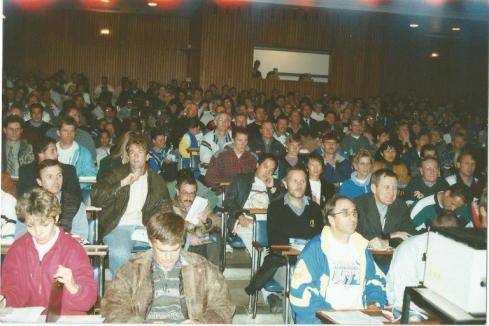
 D.O.    I could not get much advice on how to run Comrades. So two years later Denis and I started the Comrades Panel Meetings with Jackie Mekler as our first speaker. Denis had run 13 Comrades by then and I had only done 2 so I took a minor role in everything. We opened the talks to neighbouring clubs and by 1982 we were filling the SHB 5 lecture theatre and Wits. We had developed a successful format for each talk to involve Comrades Winners, a motivational speaker, a doctor and a physiotherapist. Plus the Chairman of Comrades Marathon Association, Bullet Alexander for the first one. In the foyer of the lecture theatre we always had a “Front of House” area for about 10 companies supplying Comrades related products such as shoes, training gear, supplements and books and magazines. Their exhibitors’ fee was a lucky draw prize at half time.

We initiated the endorsement by CMA and Barry Varty, Chairman in those days was very willing to provide a letter for us. We proudly displayed this “Approved Training Programme for the Comrades Marathon” on all our fliers and still do. There was no ambush marketing in those days. The “Comrades Panel meetings” were awarded their “Green Number” for supporting the runners and the race by training properly.

The Comrades Panel meetings were well respected and we assembled a similar panel of speakers including myself to create the Comrades Road Shows backed by CMA. We travelled to the main running centres from Limpopo to Cape Town ably compared by Ian Laxton one of the anchor men for the TV broadcasts.

At the scattered coastal and rural towns it was apparent that these runners had less access to training methods than the urban area so I started writing monthly articles in Runners World which indeed reached the outlying districts. I was appointed the first Comrades Coach to give talks and set up a forum on the Comrades website.

We soon had a very active response from website readers and we became aware that there was an international interest. I met later at Comrades with runners from Sydney, Austria and Brazil and was presented with a Brazil soccer T shirt by grateful soccer fans that had ascended to Comrades marathon status. At this stage we designed and printed Pacing Charts for race day which I compiled and was, at this stage, a green number finisher. They were sold at the Comrades Coach stand at the Expo and it was then that I realised how far and wide our training programmes had reached. I personally met my audience from the magazine subscribers and the road shows. It gave me a deep feeling of pride and satisfaction that a large percentage of Comrades novices had access to successful monthly training programmes. A sharp contrast to the advice I had for my first Comrades.

One memorable succinct reply to my question; “Should you have something to eat during Comrades?” The very dry reply was “Run fast enough and get in before lunch!”


D.J.     Are you able to guess how many runners you have taken to the finish line through the panel Talks over the years

D.O.    No doubt that we helped on average 250 runners each year for 25 years and still going in a smaller way. Minimum 6500.


D.J.     A lot of people who can thank you for those medals they have! What a lot of people may not know is that you were an above average runner yourself. How many Comrades do you have under your belt and what’s your best time?

D.O.    I completed 19 Comrades with a best time of 7 hours 25 mins.


D.J.     That’s not a shabby time. And your slowest time?

D.O.    10 hours 31 mins.


D.J.     So certainly well qualified across the time field to give advice. You have been very involved in road running administration over the years. Was that also a passion or just an “add on “to your love of Comrades”.

D.O.    I have always wanted to share the pleasure and excitement that I get from road running and the most effective way to influence people is to be an administrator. I always had clear vision of what I was trying to achieve which was always to benefit the runners at all levels. I never found the administration a burden but rather an opportunity. I was always very aware of the trust people had given me by voting for me and I always tried to give them something in return. It was therefore a commitment to improve all aspects of road running.

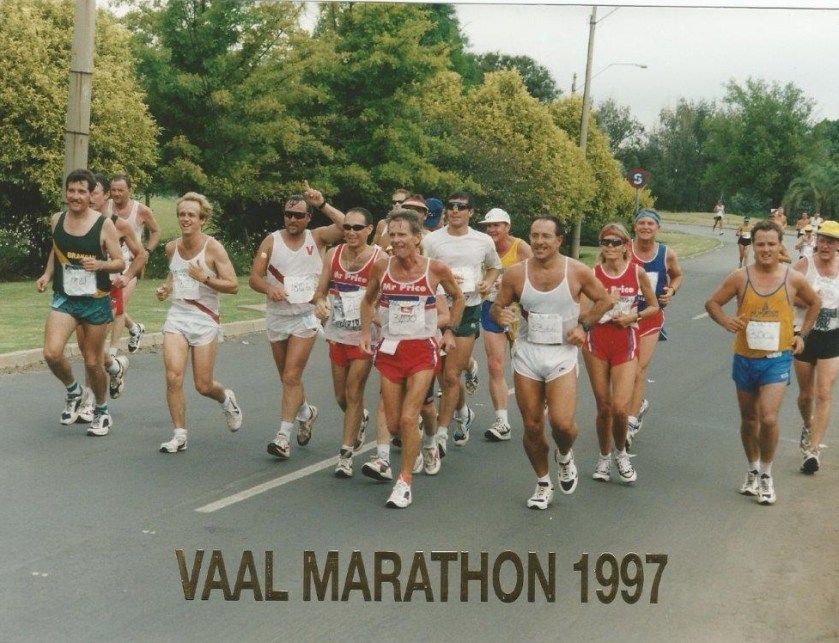
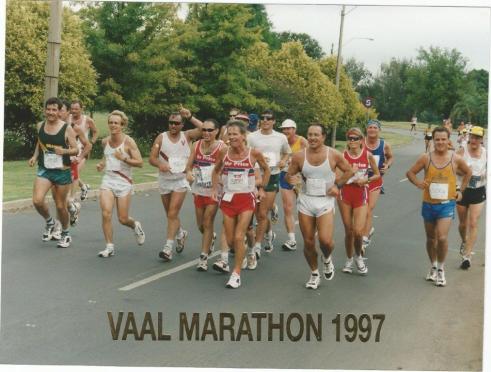
The photo above taken at the Vaal Marathon in 1997 was a Comrades Panel “Bus” to qualify in less than 4:20 to get seeding batch F to give them a better chance of a bronze at Comrades. The lady in the second row to Don’s left behind the RAC runner is Don’s late wife Olwyn.


D.J.     Do you ever see this love of this amazing race waning or is it something that you think will continue to attend Comrades for as long as you are able to do so.

D.O.    My love for Comrades is not waning as yet and I see no signs of my involvement shrinking although the focus each year does change. To attend Comrades is always a way to recharge my batteries to provide motivation for talks and articles.


If you happen to see Don at Expo when you are at Comrades, go along and say hello to him. One of the nicest and most genuine people around.


COMRADES WILL HUMBLE YOU

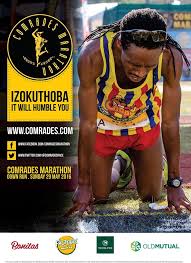
Comrades held its launch for the 91st race on 29 May 2016 under the banner “Izokuthoba – It Will Humble You” and people who have never run this amazing event could be forgiven for thinking that the banner for the 2016 race is rather silly.

I have even had a few runners say to me that they have something of a problem with the banner. “I have never been humbled by Comrades” they say, and then you remind them about “that race” or “those races”. They were humbled.

The most brilliant strategist I have ever known when it comes to Comrades has to be Bruce Fordyce and even he, I would suggest, has been humbled by that strip of tarmac between KZN’s two cities.

In one of his last runs he battled to get a silver medal and missed the cut off by something like 34 seconds. Was he humbled?

From a personal point of view, I ran my best of 8:29 in 1975 and I knew that with the right homework and approach to the race I could dip under 8 hours. I went into the race in 1976 fitter than I have ever been and hit cramp at around 32kms from the start. By halfway at Drummond I had lost 10 minutes from my 8 hour schedule and started thinking that I would probably have to settle for much the same time as I had run the year before when I did my best.

It wasn’t long before 9 hours seemed like a very respectable time and I would have to be content with that because the cramp simply wouldn’t ease. Then it was 9:30 and eventually I crossed the finish line in 10:06.

If that’s not being humbled from my initial plans and thinking, I don’t know what is? I wanted to break 8 hours but it took me longer to run the second half than it took Alan Robb who won that year, to do the entire race!

Alan Robb himself, I think, was humbled a few years later when he was favourite to win in 1979 and to notch up his fourth successive win. He finished 5th! I think he was humbled.

I am very proud of the fact that I finished that race in 1976 even though I was humbled and in talking to a top runner who was, in my opinion, himself humbled some years prior to my experience said he felt proud of his achievement in the particular year and didn’t feel humbled – but whilst entitled to feel proud, I believe he was humbled because what he thought and knew was going to happen didn’t in fact happen. Comrades had the upper hand.

If a person has never run Comrades they can be forgiven for thinking that a road race could possibly humble anyone but then they have never run it and they have never had their dreams lying in tatters on the road between Pietermaritzburg and Durban. They have never had aches in muscles they never knew existed and they have never experienced the 60 minutes that make up each hour fly past in what seems to be about half that time.

It’s been said that running is best described as an individualistic expression that depends mainly on one’s mental outlook, and when it comes to Comrades the most powerful thing you can have is a strong mental outlook. Sadly though, the vast majority of people go into Comrades not realising that 90% of that 90km is firmly between the ears and if you look back over the years, you will find thousands of cases where runners have been humbled by Comrades.

I have mentioned three top runners who I believe have been humbled by Comrades and I could make a very long list of others but it’s not the top runners alone who are humbled by the race. This works its way right through the field to the very last person home.

In most cases the story is similar to mine in 1976. They are convinced they can do a certain time and as the distance and the day progresses so does the time they are looking at, get longer.

I hear from runners all the time who say they ran a half marathon in 1:45 or a marathon in 3:30 yet they came adrift in Comrades and they can’t understand why that happened. They can’t understand why they can’t convert those shorter distance times to a meaningful Comrades time.

Don’t get me wrong when I say “meaningful” Comrades time because just to finish the race is an achievement.

In many instances the inability to convert those shorter distance times is because they have trained for shorter distances and suddenly come Comrades Day they find they are faced with virtually double their longest run prior to that. I have also said that Comrades is about 90% between the ears and 10% in the legs and having run enough of them – for me – good ones and shockers, I stick with that.

Many modern runners seem to believe that the more races in which they run, the more they are prepared to for Comrades and the fitter they are. I am happy to argue this “until the cows come home” as I am a firm believer in Long Slow Distance (LSD) in training and I have said this in previous blogs on “The Marathon”.

So when Comrades say “Izokuthoba – It Will Humble You”, are they saying be afraid. Be very afraid?

I don’t for one moment believe that’s what they are saying at all. I believe they are saying that every runner should approach the race with respect. Every runner should do the training to run 90kms and every runner should do the “off road preparation” they need with pacing schedules that suit them.

Only by studying the route and by training properly can a runner have a pacing schedule for Comrades to suit them. A schedule printed in some booklet and prepared by somebody they have never even seen is an invitation to be humbled.

If I had R10 for every time I have heard people who know Comrades say “Don’t run in too many races in the five months before Comrades” I would be able to take myself off on a very pleasant holiday but yet runners are out there week after week running in races and during the week in club time trials. The result? They get to Comrades either very tired or nursing an injury or have run their immune systems to the flu.

Approach Comrades with respect. Train for 90kms and not for 50kms. Get your speed comfortable. Study the route over and over but DON’T look at the route profile. The route profile is enough to make the toughest runner go whimpering off into hiding. Set your own pacing schedule at the beginning of May. Don’t try anything new after the beginning of April.

Do all those things and Comrades is yours but even if you go through the day perfectly you will probably get to the finished humbled.

One definition of “humbled” I have seen, reads “Feeling the positive effects of humility” and that’s the way I felt when I ran my best one – and every other one I ran.

“Izokuthoba – It Will Humble You”