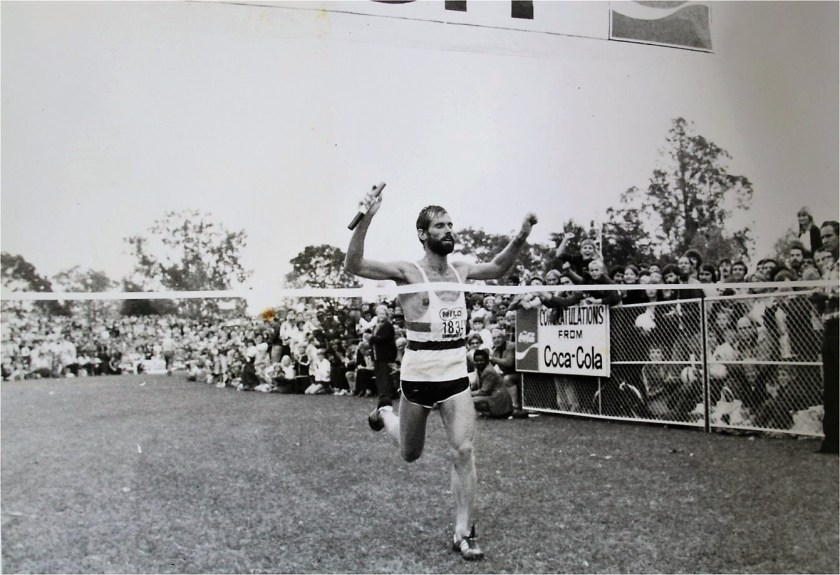
RESPECT COMRADES. IT’S FUN BUT NO JOKE

So your Comrades entry for 2019 is in and you’ve had confirmation from the organisers that they’ve received it – so now what? 

Easy.  All you now have to do is to run a qualifier before the beginning of May and pitch up at the start of Comrades on the 9th of June, but is it really that simple?

With the right approach, I think it is, and I honestly think that the right approach is not hard to achieve.

During the last couple of years I’ve asked myself the question, more than once, whether my relationship with the Comrades Marathon is a passion or an obsession.  I don’t really know what the answer is because the two words are pretty closely related except that one of them conjures up thoughts that are not quite as nice as the other but look at the dictionary and you will find that the word “emotion” features in both definitions so I guess it doesn’t matter too much which it is.

Suffice to say that I have a pretty deep feeling about that strip of tarmac between KZN’s two cities and I am not able to explain it but ridicule the race or don’t treat it with the respect it deserves and I won’t treat you with the sympathy you would perhaps like if you run it and come horribly “unstuck” during the race. This isn’t something new. I’ve felt this way going back as long as I can remember to my very early days to when I first started running Comrades.

Go into Comrades with no respect for the race, come undone and suffer badly and it’s your problem and you’ll get no sympathy from me and I was sitting thinking about the way I feel about people who take part in the race and who, especially in their first run, don’t take it seriously.  It doesn’t often happen to people who have run it more than once. Those people have learnt that Comrades deserves respect and they give it the respect it deserves.

I have often heard novices say they are really scared and my reaction is always that they shouldn’t be scared of Comrades but if they are properly prepared both physically and mentally for Comrades they need to respect it but not fear it. To my mind there’s a very big difference.

I have never feared Comrades but I have certainly respected it.  I have run it 14 times, finished it within the time limit all 14 times and respected it every time and I believe that’s how I was able – even when I suffered badly – to finish the race and to go home with my Comrades medal every time a ran.

Some people regard it as something of a giggle when they enter and right up to the start and even into the race and perhaps even as far as the first 30km or so and until they start to hurt just that little bit when the first of the hills starts to “talk” to them and there is a tiny change of opinion. Comrades has put people into hospital and ICU with such things as renal failure and which sadly in some cases has even claimed the lives of runners who have gone into Comrades perhaps not as prepared as they should be because they think they know better.

In days gone by when we were asked where Comrades started the answer was always “at the 60km mark because anyone can run that. It’s the rest of it that’s the problem” and that’s always been and still is the case.  I was driving between Durban and Pietermaritzburg recently and when I got to Cato Ridge I had visions of my own Comrades days of getting there and remembering what it felt like to be there and that sometimes that feeling of despair knowing there was still over 25km to go and that I was tired but at the same time I was fit and had trained for this.

I heard recently about one entrant who had a longest run of a qualifying marathon in a time of around 4:14 which she considered made her a fast runner and as a result she intended starting Comrades fairly fast. She had no intention of studying the route or listening to anyone talking about the dangers of the first 25km of the Up Run or the first 20km of the Down Run because she felt she didn’t need to do this.  She also saw no need to run any other long runs in preparation for Comrades. She had done a 42Km run and done it quickly!   Somebody should have mentioned to her that a 4:14 marathon isn’t exactly quick and that it’s pretty average and slightly slower that 6 minutes per km!

Unless she is Supergirl in disguise, that particular lady was going to be in for a very long and painful day on Comrades day if she is able to make it past the 60km mark which seemed doubtful.  I had a problem feeling sorry for her. That sort of arrogance didn’t deserve any sort of sympathy.  The problem however is that she could have become a negative statistic that Comrades really doesn’t need. I have no idea whether she finished that year or not.

I have often heard people say “If Comrades was easy then everyone would do it” but not everyone does it because it’s not easy.  Speak to cyclists and many will tell you that they stick to cycling because it’s easier than running.  I am an avid Twitter follower and there was a Tweet I really enjoyed by someone I don’t know that appeared that read

“Running is stupidly hard.  It’s worth doing once in a while to remind oneself how good an idea the bicycle is”

He said it – not me!

I know one young lady who, a couple of years ago claimed to be very fit and I think she was, so she entered for, and completed, the Iron Man in Port Elizabeth.   I’m told that this event is very tough and you are quite something if you can complete it.

About six weeks later she took part in Comrades. She ended up in ICU in hospital for 4 days with renal failure.  No problem with Iron Man. Comrades put her into ICU.

Comrades is not a joke and it should never be treated as a joke.  I have seen some very sick people at the finish of Comrades.

The Comrades doctor told me that the majority of the people treated in the medical tent at the finish of the race suffer from exhaustion as a result of under training yet we see runners year after year treating this race as something of a joke.


The wakeup call on Comrades day I would imagine, is when you realise that after your qualifier distance, you are only at around half way, and you have the same distance to do again and then a little bit more all on the same day.  Sure you need to be mentally strong but if you are physically weak for distance running from not training properly, then your mental strength has nothing with which to work.

In 2016, the Comrades banner was “Comrades – It Will Humble You” and there are thousands of us who have been humbled by this race and who have prepared properly and it’s still happened.

I clearly remember the 1976 Comrades and I was probably fitter than I had ever been.  I had run my best ever in 1975 and I was aiming to do even better in 1976. It was a Down Run and I was on schedule at Cato Ridge at around the 30km mark but by the far end of Harrison Flats, just a few kilometres further I felt a niggle in the muscle at the top of my right knee that definitely shouldn’t have been there.

I wasn’t too worried about it, but by the time I got to Drummond I had decided to adjust my finish time by an hour that would still give me a comfortable 9 hours although the muscle was getting worse.

Alan Robb won his first Comrades that year and I ran the second half quite a bit slower than Alan had run the entire race because of that muscle at the top of my knee and that in the year I was aiming for my best ever Comrades.

I understand fully what the 2016 Comrades banner read “Comrades – It Will Humble You”.  It certainly humbled me in 1976.  I was over two hours slower than the time I knew I could run and the time I had set out to run all because of a muscle at the top of my knee.

The question I ask myself then is how am I supposed to feel about these people who have no respect for this thing which is something that for me is such a passion and for which I and so many others who have run that road many times have such respect?

If you’re reading this and you’re going to be running your first Comrades this year and fear is starting to build up as you read, please don’t let fear be there. I have said to many runners and particularly to many novice runners that they shouldn’t fear Comrades but they should certainly respect it.  That they should respect it whether it’s their first Comrades, their 10th Comrades or their 20th.

I have taken people to see Comrades as spectators.  People who have never seen the race before and the reaction has been amazing but usually along the lines of “how do they do it”?

It doesn’t matter how many times one has run it, one should always respect it because Comrades is bigger than any of us and it deserves our respect.


November 2018

WHY RUN COMRADES? :

We’re getting towards the beginning of August and that means in just a month’s time entries for Comrades 2019 will open and if we look at the speed at which entries were snapped up for 2018 I have no doubt the same thing is going to happen again for next year albeit an up run which, incidentally, I have always preferred.

This means that a tremendous number of novices, fired up by Comrades 2018, will, in all probability, be giving serious thought to tackling the road between Durban and Pietermaritzburg on the 9th of June 2019

I’ve been around Comrades a very long time.  In fact, I’ve been around Comrades longer than most people have and I have often been asked “Why run it because it can’t be good for you.”

I know one chap who won’t run it for that very reason. He feels that he would rather give Comrades a miss than risk any sort of permanent damage to himself.  I feel very sorry for him because of what he’s missing but that’s the decision he’s made and I would never try to change his mind. He’s of the opinion that Comrades is simply a race to see who can get to the finish in the fastest time and is not really any different to any other race.

It’s so very much more than that. Only 51 men have been able to win this race but many more have tried to do so and failed but it’s not the winners I want to talk about.

It’s the ordinary runner. The person who has perhaps watched it on TV for the last number of years and has finally taken the decision to run Comrades and earn that prized medal.  Comrades is, however, much, much more than just that very precious medal but make no mistake, it is a very precious medal.  Small in size but massive in meaning.

20151130_163928

Let me try to explain.

I have a couple of permanent injuries because I ran all those Comrades all those years ago in shoes that one could hardly call ideal but I have often said to people that had I been told when I was 21, and I was about to run my first Comrades that when I reached 70, I would be suffering from a very bad back and very bad knees because of those Comrades, I would still have run the fourteen I ran, because Comrades gave me so much more than it ever took away from me and it did that in so many different ways, not only in the running world but in life in general.

Allow me to give you just a few examples of the things Comrades can offer you for the taking and all you have to do is to realise that they are there and take them and use them.   

There’s the old saying that Comrades isn’t easy because if it was, then everyone would do it, but it’s not easy and this is confirmed by that very small overall number of people who have done it since it was first run in 1921.

We’re not sure of the exact number who have run Comrades since it started but we guess between 150,000 and 200,000 but as a percentage of people from the eligible age and health group in a country that now has 57 million people of whom probably at least 15 million are in the right age and health group to take part, it is pretty small percentage.

In fact it wasn’t until around 2000 that the numbers actually picked up when the race organisers increased the time limit to 12 hours making it that much more accessible to many more people who might otherwise not have attempted it, have the numbers increased in any significant way.

There are other factors that come into play obviously, such as the restriction on the number of entries that the narrow “old road” can safely handle as well as the facilities at both ends of the race.  Imagine an entry the size of one of the major overseas city marathons trying to fit onto the road through Drummond!

Then there’s this inexplicable thing of why it is that so many of us go back and run it again and again and if you ask anyone who has run more than once, why they’ve done so, you’ll get a variety of answers many of which don’t really make a lot of sense.

Many years ago I sat down and something came to me and I put it down and when Comrades themselves saw it they even used part of it on their banners for the 1999 race and on the front of the runners’ T shirts that year and the “verse” they chose to use from what some people called a poem, was 

It’s something that changes lives forever

and makes those who do it different

Not only to others but to themselves.

It takes ordinary people who struggle to achieve mediocrity

and allows others to look up to them in awe.

COMRADES T SHIRT 1999

What I was getting at in the verse I quoted above when I said that Comrades takes ordinary people and allows others to look up to them in awe is seen in the reaction of non-runners who find out that you have run Comrades. It takes ordinary people who are no more than mediocre in most things they do in life and allows them to move beyond that mediocrity somehow. They are suddenly seen in a different light.

It certainly did that for me and people still look at me in awe when they find out how many I ran – and I only ran 14 of them. That’s nothing compared to some people.

The other thing I have always found amazing and I recently had a huge disagreement with the same non-Comrades runner I’ve mentioned, who regards Comrades as he does any other road race, about this because he simply couldn’t understand it, was that people very seldom ask me what my Comrades times were, but are far more interested in the number I’ve run and the response to that is then “WOW”.

To the ordinary public, Comrades times don’t mean a lot. The number of times you’ve run Comrades means a huge amount!  To the ordinary South African there’s a kind of magic associated with Comrades.  A magic that’s difficult, if not impossible, to explain to someone like my non-Comrades running friend.

Comrades is more than simply a road race between two of KZN’s cities. It’s a lesson about life and if you come away from Comrades having learnt nothing then it’s best to have a good hard look at yourself because you’re missing something important.

One of the many things it taught me is that sometimes we throw away the opportunity to do things better than we actually end up doing them.

My final Comrades in 1987 was a fairly hot day, and at the time I didn’t know it was my final Comrades as the injury that eventually stopped me from running hadn’t made itself known at that stage. It did very shortly after that and before I had the chance to run my 15th.

On that Comrades morning I stood at the start line prepared to run under 9 hours.  I had run under 9 hours a couple of times before and close to it a further few times so I knew I was capable of doing it and I had trained to do it again but when I realised how hot it was and how hot it was going to be my attitude was “I couldn’t be bothered” and I ran to a very sociable 10:14 and that was way slower than the limit of my ability and I knew it was.

In hindsight it was NOT the right thing to have done and I still regret it over 30 years later when I stupidly decided to run my sub 9 “next year” but “next year” never came because the permanent injury and the end of my running came instead.

I should have aimed for it because I could have done it had I tried – if only I had tried but now it’s too late. How many of us do things like that? Not only in our running but with many other things in life.

We don’t give it our all “because we couldn’t be bothered” just as I had done on that Comrades morning in 1987 and we never get the opportunity again. That’s very sad and even worse when we can look back and realise that we have done it to ourselves.

It was after that 1987 Comrades that I messed up because of my “couldn’t be bothered” attitude that I was most successful in business and other things I tried. There was no way I was going to adopt that attitude again and lose any more opportunities in life!

Just one thing of many things Comrades taught me.

Back to my original question though. Why do people run Comrades?  Is it a challenge? It’s certainly that without any doubt and with the time limit having been increased to 12 hours instead of the old 11 hour limit, this has made the challenge a bit more accessible to a lot more people.

Does this mean that it’s a lot easier?

Not at all.  It’s just a lot more accessible to a lot more people. Durban and Pietermaritzburg are still where they have always been and on the Down Run this year the total distance was a touch over 90km and the third longest Comrades ever, so it was certainly a challenge.

comrades finish 2018

PHOTO: pdgpix.com

To cover 90km on foot in under 12 hours is a challenge make no mistake. It’s a huge physical challenge to the ordinary person but what is probably an even bigger challenge is the mental aspect of it all. When you’re out there on the road on Comrades day it’s just you and the road to the finish and you get the opportunity to prove to yourself exactly what you’re made of and that’s another thing Comrades taught me.  I learnt not to give up on something I had started and that was something that was to stand me in good stead in ventures in later years.

The runners up at the front are in a race against other runners but those further back are in a race against themselves or against the clock.  If you’re in your personal race against the clock, very few people actually care what time you run.  Will I do this? Can I do this?  People are more interested in whether you finished rather than the time in which you finished. To a non-runner your time doesn’t mean much and other runners are more interested in their own times than they are in your time.

When you are on that stretch of road still some distance from the finish and every part of your body is screaming for you to stop and your legs are aching and your head is telling you that you can’t actually go on but you know that you must go on because you need to do this that’s when you learn about yourself and those words were never more real.

It’s something that changes lives forever

and makes those who do it different

Not only to others but to themselves.


That’s why you run Comrades.


July 2018

COMRADES 2018 – ANN ASHWORTH, WHO IS SHE? :

COMRADES 2018 – ANN ASHWORTH, WHO IS SHE?I was privileged to have been part of the seconding team of this year’s Comrades women’s winner, Ann Ashworth, and once I had got myself to the finish in time to see her cross the line, I made my way to the VIP lounge where I saw several of my running friends from many years ago.  When they found out where I had been earlier in the day, I was asked “But who the heck is Ann Ashworth?”

I was delighted when I was asked this question because this meant that we had successfully sheltered Ann from too much media attention and this had allowed Ann to get on with her race preparation unhindered.

The question though as to who she is still needed to be answered.  Once things had settled down a bit a few days after Comrades I sat down with Ann, a good friend, to ask her what the rest of the media hadn’t already asked since Ann’s brilliant win on the 10th of June.

ANN ON THE ROAD

I knew Ann was from Howick in the KZN Midlands but is that where she was born?

AA:     I was born in Harare, Zimbabwe, then moved to the Eastern Cape for a few years, spent a year in what was then known as Zululand and then, when I was four, moved to MerrIvale, which is now considered a suburb of Howick.  I grew up in Howick, did all my junior preschool, junior school and high school in Howick and then completely my first year of university in Bloemfontein.  While I was in Bloem, my Dad got very ill and I decided that I didn’t want to be so far away or in Bloemfontein and so moved back home to Howick and did my law degree in Pietermaritzburg.  I then only moved to Johannesburg when I got my first job as a candidate attorney.


DJ:      Now when you went to varsity, had you already decided that law was the way you wanted to go and that was the way you studied?

AA:     No, when I did my year in Bloemfontein, I actually thought I was going to do Sports Physiotherapy.  I thought that that was a good way to keep in touch with sport and be active and just stay healthy.  I also thought that was quite a nice career option and my parents were quite in favour of that because it’s easily transportable. You know, you can move anywhere in the world and take your physiotherapy skills with you and at that stage there was a lot of movement, a lot of people were still emigrating, it was still quite uncertain and so they thought that was a good option.  But six months into physiotherapy, I knew that it wasn’t for me.  I didn’t like how medical it seemed to be.  Not that I wasn’t interested in the human body, but it was just….. it was very little sports physio and a whole lot of rehab and medical physio as part of the training, and I didn’t enjoy it at all… and so then decided to study law after that.   Law had always been my second option to physiotherapy, so when physiotherapy was off the table, we then went back to law.


DJ:      Had you by this time, in school maybe or in varsity, already developed an interest in sport generally – general sport?

AA:     Well I’m an only child and so only children tend to do a lot of sport as a way to meet and interact with other people – because you don’t have siblings to play with and so I did do sport at school.  I did hockey, I did water polo quite badly because I’m too small to play water polo.  I swam a lot.  I was swimming up to four hours a day in the summer months and really training quite seriously as a swimmer.  Swimming was definitely my best-performing sport at school and then really just did cross-country in the off-season to keep fit for swimming and same with track.  Track was the only sport offered in the third term at my school, so everybody did track and I was okay.  I really only came into my own in the second half of high school, so from standard eight, nine and ten…..


DJ:      Are you talking about athletics now?

AA:     …….and cross country.  Senior High was really when I started to realise that, look okay, I actually can run, but that’s relatively speaking, because I grew up in Natal and Natal was always on the back-foot in terms of athletics and cross-country.  I mean when we came up here to compete against Transvaal schools,  you know, Natal was always last, so I didn’t really take my running seriously at all.  It really was just something else that I did when I wasn’t swimming.


DJ:      Why do you think that is in terms of the Natal schools?  Do you think that something like Comrades hurts athletics in schools?

AA:     I don’t think so.  I think that the weather has a lot to do with it.  Because it’s so hot and humid in KZN, our terms are not aligned with the rest of South Africa, so we swim….  In Natal, you swim in the first and fourth term, you then do cross-country in the second term and track in the third term, whereas in the Northern Provinces your track is year round and we’re only running on a term, maybe two terms worth of training and fitness, whereas the Northern Provinces are doing it all the time.  Perhaps the Northern Provinces aren’t as good as Natal in terms of your water polo or your swimming or things like that, but I think it has a lot to do with the climate.  I cannot imagine running any kind of long-distance in Natal in February.  I mean it’s too hot.


DJ:      Yet they do.

AA:     It’s crazy.  I definitely don’t think school children should be doing it.


DJ:      When you were running track in school, what were you doing?  800 & 1500?

AA:     800, 1500, 3000.


DJ:      As much as that?

AA:     Ja.  We could only do 3000 as a senior, so for standard 6 and 7 (now Grade 8 and 9), we could only do 800 and 1500 and then when I was a senior in high school, we could do the 3000.   My school only had one race for the 3000.  Boys and girls of all ages and shapes and sizes in one race, so I mean (chuckling) it wasn’t very serious.  I did come up to Pretoria every February.  There’s a Menlopark Athletics Meet, where they invite schools from the Midlands and I sometimes I won those races, but really, I didn’t take it seriously at all.  Ja and then I did do SA Cross Country Champs for four out of five years, so you know I was running…


DJ:      Did you feature there?

AA:     No.  Top twenty maybe, you know, it just wasn’t my priority.  I just wasn’t fast enough …. And I wasn’t serious about my training, I really just did it to keep fit, but you know, I wasn’t super-competitive.


DJ:      When did that start?

AA:     In matric I actually got a partial Sports Scholarship to Bloemfontein to do my physiotherapy and then as part of that scholarship, had to join, obviously the Kovsie Track Group.  That group was super-serious compared to the easy-going English girl from Natal. There were a lot of very serious Afrikaans girls, who thrashed me, quite frankly and I thought, “Shu, I’ve really got to do something about this.  I can’t be here on a Sports Scholarship and not be performing.”, but I actually cracked under the pressure.  I became severely Anorexic.   My studies and my running went completely off the rails.  My life generally was a bit of a train-wreck and as I got more and more Anorexic, my running performance got worse and worse, to the point that I stopped running altogether.  I didn’t take up running again until after my Dad died.  My Dad died in September 2007 and about a month later I signed up for Two Oceans and for me that was the way I was going to honour my Father’s memory, because he had always thought that I should do long-distance road-running.


DJ:      Now it was he who actually introduced you to Comrades when you were very little.

AA:     Ja, so my… well both parents.   My parents used to watch Comrades on the TV all day and so it became a family tradition.  There was nothing else on our diary for that day.  We’d all sit around in our pyjamas and watch Comrades and if it was an Up-Run, we would go out on to the route and we would be anywhere from Cato Ridge to the Finish.  The last year that Bruce Fordyce won was an Up-Run and my Dad and I were actually walking up Polly Shortts.  My Mom was also on Polly Shortts, but we weren’t together at that particular moment, when Bruce came past us and I turned to my Dad and I said one day “I also want to run this race” and he said like, “Ja, you go.  You must do it.” and it’s something that just never left me.  Every time that we watched Comrades whilst growing up I always thought like,   “Ja, one day I’m going to run this race” and it really was just a natural step and Two Oceans is a lot less further than Comrades, so that seemed like the first race that I should enter.


DJ:      Now when you said that to him, you must have been what…. Six?

AA:     Six, ja six.


DJ:      And that was it.  Decision made.   No changing.

AA:     Ja, everyone knows once I’ve set my mind to something, it’s not going to change.


DJ:      Even from the age of six?

AA:     Ja, I always knew.  There was no question in my mind.  I was always going to run Comrades.


DJ:      You’d made your decision that you were going to run Comrades, yet you only ran your first one, probably when you were what….. 26, 27, 28?

AA:     26 I think, – 2008 – which is 24.


DJ:      Which is actually fairly late having decided to run it at the age of 6?

AA       Ja, you know I always had this idea in my mind that you didn’t really start running Comrades ‘til you were 30, like 30 was a nice round number.  So when I got to 30, that’s when I’d run Comrades and so I didn’t really think about it.  I just sort of thought,  “Ja, ja, I’ll get there in the future.”, but when I started working as a Candidate Attorney in Jo’burg, my boss – or my immediate Supervisor – was a guy by the name of Anton Roets, he was a complete Comrades fanatic.  He had done nine at that stage and he invited me to go for a couple of runs and like….. he’s your boss and he wants you to go for a run with him, so you go and we would do like 5 k’s around Illovo together and then I joined up with his running club and you know, I’d go and run a half-marathon with his group of mates and you know, it was quite sociable and he said to me, “Ann, I think you need to enter Comrades”, but he didn’t think I was going to be serious about it.  He was like,  “Come and run Comrades.  Let’s be sociable.” and I’d met a lot of his friends in the running club which was a club called,  “The Legends” and it was a nice group of guys and I thought,  “Ja, okay that’s nice and sociable….”


DJ:      Now were you running other races at that stage?

AA:     Not even so much.  I mean I’d do like a marathon, but nothing more than that…… but not even lots of marathons, like maybe two marathons a year, like Slowmag and Soweto.


DJ:      Socially?

AA:     Socially, completely socially.  I actually ran my first Soweto Marathon in 2007 and that’s how it started I think.  I ran Soweto as a fund-raiser, to raise money for an orphanage just outside of Johannesburg and basically I just asked people to me money per kilometer over 42 kilometers.   It was after Soweto that Anton said like,  “Well you’ve run a qualifying Marathon now, you might as well sign up for Comrades.” and that’s really what got me in.  I ran Comrades the next year.  I think I trained four days a week and maybe did…… I think I did two or three long runs, but really socially.   I mean, I think I actually ran a long run with The Legends and our long run of 60 k’s ended up taking me far longer than I actually took to run Comrades, like it was really slow and then ran Comrades and I finished on 8:01, which for a first Comrades is not bad.  I was first Novice ……


DJ:      But somebody had to realise that there was something there if you did 8:01 in your first Comrades?

AA:     No, well….. so ja, I mean I did an 8:01 and I was First Novice and I won my age group and then Bruce Fordyce came to the “aches and pains” party or another Comrades-related function for our club and everybody there, all my mates at the club were like “Oh this is Ann.  She did the best out of the club.” and he said,  “Well what did you run?”  I said, “8:01” and he looked at me and I was like expecting him to be like “Oh well done, that’s great.” because that’s all anyone had said about my 8:01 and then Bruce looked at me and said, “Well, what went wrong?” and I said,  “What do you mean what went wrong, that’s a great time!” and he was like,  “No-one runs at 8:01.  You should be running a 7:59…. at least.” and I was like,   “Okay….fine….  Let me try and now break 8 hours”.  

Around about the same time I had asked another coach to help me and he was terrible, so terrible that I ended up not running Comrades the next year (2009), because the guy totally tanked my running.  For some reason he thought that I should focus on half-marathons, even though I told him I wanted to do Comrades, but by the time we parted ways I was completely under-cooked to do a Comrades.  So after the 2009 Comrades which I missed I messaged Bruce and I said,  “Well, you know, you said that you thought that I could run under 8 hours.  Why don’t you coach me and get me under 8 hours?”

At that stage he hadn’t coached anybody and he said,  “Look I don’t do coaching.  I don’t do this.  This is not what I do.” and I said,  “Ag, come on, let’s just try.” and he said,  “Okay three months to Cape Town Marathon. I’ll try and get you under 3 and a half hours.  

 Like literally, I was running like 3.45, for a marathon and he said,  “Three months training.  Let’s see if we can get you under 3 and a half hours and if it works out, then I’ll continue to coach you and if it doesn’t, we go our separate ways.”  So I said, “Okay, deal.” 

 So I trained with Bruce for three months, then a 3.27 at Cape Town and was thrilled.  I thought,  “Wooh, under 3 and a half hours, that’s amazing!” and then entered Comrades and Bruce then trained me for that Comrades and I ran my first silver medal in 2010.  After that I was hooked.  Then I was like,  “Silver medal…..”

ANN AND BRUCE

Bruce encouraging Ann during Comrades 2018 whilst seconding her

 DJ:      That was your second Comrades?

AA:     That was then, yes, my second Comrades and now that I’d had a taste of that silver, now I thought, “Shu, now we’re going to work hard.”  So it’s been quite a long journey…..


DJ:      …..to here….

AA:     Ja.  (laughter)


DJ:      How many left?

AA:     I said I would never do more than 10.


DJ:      ….and you’ve done 7”

AA:     7 – Ja, so I’ve got three left


DJ:      Moving away from that altogether, when you started getting serious about Comrades and training and all that sort of thing, you obviously needed a training partner, so you went and married one.

 AA:     (Laughter)


 DJ:      How did you meet?

 AA:     So during the time that Bruce was coaching me and I ran my silver, I was running for the Nedbank Running Club.  At the end of that year there was a prize-giving at the running club.  David was the top-performing male runner at Comrades and I was then the top performing female at Comrades and so we attended that prize-giving separately.  I took a boyfriend that I was dating at the time and David came alone and Gill Fordyce introduced us and she was like “David, this is Ann.  She was the best female athlete” and “This is David.   He was the best male athlete” and immediately I was like, “Now that’s cool.  Like… now I might have somebody that I could run with.  

So we became quite friendly and for me, I was like “No, I just want someone to run with, I’m not really interested.  I’ve got a boyfriend.  I don’t need another boyfriend” and so we went for coffee a couple of times and ja, David just pursued me relentlessly and …..


 DJ:      And the rest as they say?

 AA:     Ja, the rest is history, ja.   Well his side of the story is that, he met me at the dinner and thought,  “What the heck is Ann doing with that stupid guy?”  (laughter).   But ja, after a couple of coffee chats, I actually then found out that I had a scholarship to go to London and I was open with David and I said,  “Look, you know, we can’t really be dating because I’m going to London for a year.” and David’s attitude was “That’s fine, I’ll come with you.”  and so within three months of dating, David came with me to London for a while and then came back and we did a six month long-distance relationship, where we ate dinner every night together over Skype.  I would make my dinner and he would have his dinner and then we’d Skype eating dinner together, which was very romantic and then about two weeks after I got back, after finishing my studies, David proposed and I said “Yes” and that’s where we are, six years later.


DJ:      Now when people ask “Who the heck is Ann Ashworth”, we know

AA:     Now you know all about me…..
ANN FINISH LINE

21 June 2018


TO WIN COMRADES :

The more I have written about Comrades in this blog and in other articles over the years and the more I have spoken to winners over the years the more I have realised just what an enormous achievement it is to win Comrades.

Think about this. At the time I write this, we have had 93 Comrades Marathons starting with that very first one way back in 1921 and we have had just 51 different men’s winners.

Pause for a moment to let that sink in.  In 92 races we have had 51 different winners. That tells us just what an enormous achievement it is to win Comrades. Only 51 men have been able to win this race.

Obviously there have been the multi race winners but that takes nothing away from those who are single race winners when you think of the very long list of those who would dearly love to win this race but have just not been able to do so.  Those who have had to be content to go home year after year with a gold medal but no winner’s medal.

Make no mistake though, to go home with a gold medal is still something pretty special.

The trouble is, that whilst it is very special to win a gold medal or a collection of gold medals people tend to forget the person who finishes second, no matter what the sporting event is.

To demonstrate what I mean, Hardy Ballington, who was a five time winner and who is remembered for that achievement, had a younger brother John, who won 5 gold medals in Comrades with a best position of second in 1949.  Does anyone remember that?  

He wore race number 26 and that was long ago reallocated to the late Ian Jardine who turned it green so even the “honour” of getting a green number for John’s five golds for the number he wore was lost because things were different.

Green numbers were first introduced in 1972 so John Ballington’s number 26 had been reallocated long after he stopped running and long after the concept of permanent numbers for 5 gold medals was even thought of.

I have tried to find somewhere that John Ballington’s 5 gold medals are recognised and I haven’t been able to do so.  He wasn’t a winner – he came second and had a collection of gold medals!

I think also of that fantastic runner from Collegians Harriers in Pietermaritzburg, Gordon Baker. Many runners from the modern era won’t even know the name.  Gordon ran Comrades nine times and won eight gold medals but just couldn’t win the race itself.  The result is that today he’s basically forgotten by most people except those of us who knew him from way back when. 

I have been privileged to have met many of the winners since the sixties and when you speak to these chaps they’re ordinary people and most of them quiet and unassuming – until you see a few of them gathered together and you realise that there’s a bond that holds them together.

That bond that says “We’ve won Comrades” and they don’t have to actually say a word, it’s just there.  A magic in the air that you can feel and almost touch. 

I heard Bruce Fordyce recently refer to the Winner’s Trophy jealously as “Our Trophy” and he made it clear that they don’t actually want just any name on that trophy and if your name is on there you have to earn the right to have your name there and he wasn’t being big headed about the way in which he said it although he had every right to be so. 

It’s a very special club and not just anyone can join and from what I’ve seen as an outsider looking in, it doesn’t matter how many Comrades they’ve won to be recognised by the members of that “special club” they all seem to be equal in each other’s eyes.  All that matters is that they’ve won.

I have had people tell me that it was easier in the “old days” to win Comrades when the fields were smaller and slower but I think that’s rubbish.  Maybe the fields were smaller and slower but there were challenges of different sorts that made winning just as big an achievement as it is today.

Some of the biggest winning margins were recorded in “the old days” when the fields were very small but so too were the two closest finishes in the history of the race when fields were much smaller than they are today so that sort of throws that argument out the window.

I remember that after the 2016 Comrades I organised a dinner with Alan Robb and Tommy Malone and the reason for the dinner is that it was 60 years since the year I had first seen Comrades, 50 years since Tommy had won his Comrades and 40 years since Alan had won his first Comrades so I thought that it had some significance – the 40 – 50 – 60 year celebration.

TOMMY MALONE 1966 FINISH

It was a very pleasant evening indeed and with Tommy’s daughter and son-in-law who were also present and who have also run, there was a total of something around 80 Comrades medals between us but the focus was on Tommy and Alan who were winners. The rest of us didn’t really count.

At my 70th birthday party last year the theme was Comrades Marathon (could there have been anything else) and amongst the guests there were a total of exactly 100 Comrades medals and that included two winners.  They were the two people on whom the attention was focused. The rest of who had run just happened to be there and it was my birthday party!

Winning Comrades is a huge achievement.

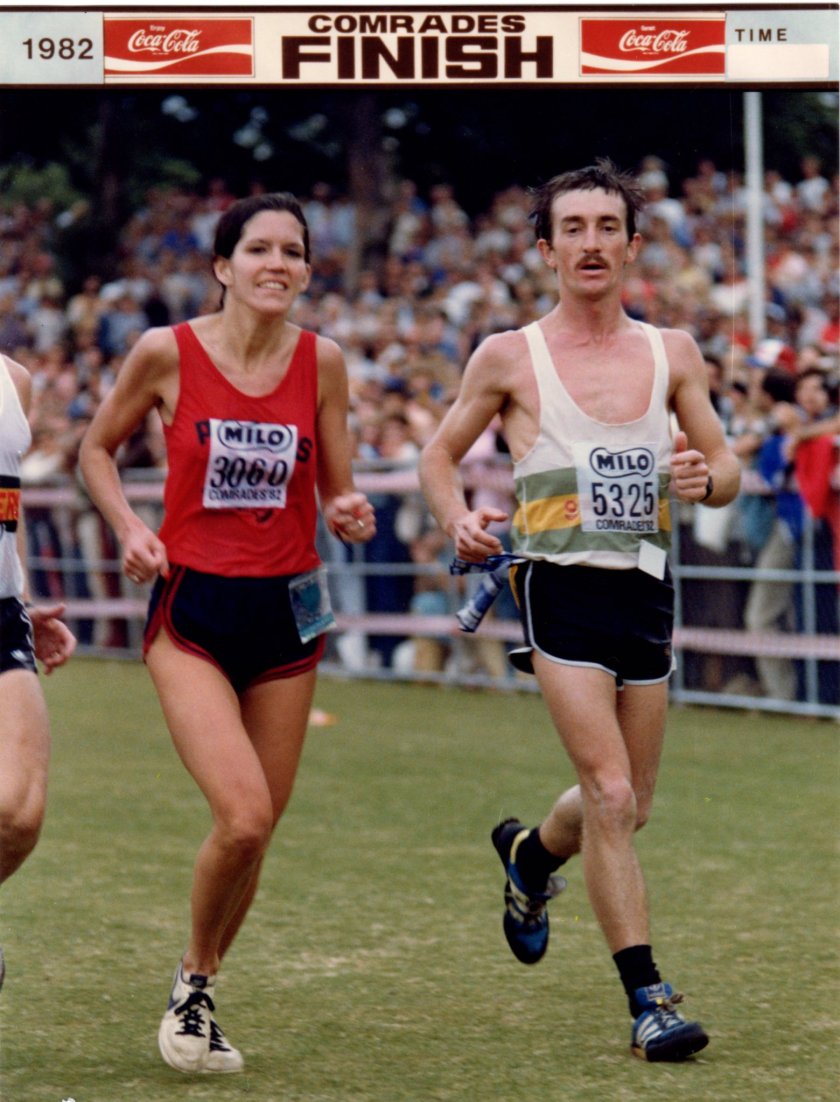
I have seen 59 Comrades Marathons at the time of writing this and I am looking forward to seeing my 60th in June this year and recently I was given an old DVD of the 1979 and 1982 Comrades which were won by the late Piet Vorster and Bruce Fordyce respectively.

win (1)

I sat watching this DVD and I was reminded again of the speed at which those two guys had to run to win Comrades.  It’s simply mind blowing and I have seen a lot of Comrades and I still marvel at the speed at which the front runners go and for the distance at which they have to run it.

For many years when I was reporting the race for 702 Talk Radio I was on the road alongside the front runners and it was fascinating to see the strategies  and to watch as one by one they faded and the favourites came through. Then you would hear comments such as “Fordyce is starting to make his move” or “Fordyce is starting to come through”. 

bRUCE WINS

Bruce was an amazingly strategic runner and from where I was, it always looked to me – and I may well have been wrong – that he let the others come back to him.  Sure he seemed to increase his speed a bit in the second half but the others did most of the work for him – or so it seemed as I watched and I have heard him say this in talks he has given. He let them come back to him.

I remember one year I had that great athlete Sydney Maree as a passenger in the 702 car with me and we were on Harrison Flats following the leader who was on his own out in front and Sydney said to me “Do you think he’s looking good”.

I said “Nope. He’s just blown. Watch. In about 1km he’ll be walking and in 2km he’ll be out”.  That particular runner was another who thought he was going to win when he was some 30km out but who wasn’t even going to go home with a medal of any sort and he didn’t!

It’s a huge achievement to win Comrades and not just anyone can do it!

After the 2016 Comrades when David Gatebe became the first person to run under 5:20 and we were told that his average speed was 3 minutes 33 seconds per km for the entire 89kms someone asked me at what speed I had run in my best Comrades.  Not knowing the exact distance of the 1975 race when I ran my best time of 8:29 I guessed it was around 5mins 50secs per km and I am pretty damn proud of that. It was a huge effort for me.

DAVID GATEBE

But when you think of David Gatebe’s 3:33 per km you suddenly realise just what an incredible achievement it is to win Comrades.  At my best I wasn’t able to run even one km at David’s speed let alone 89 of them one after the other!

So before you watch Comrades from in front of your TV and grab for another beer as the winner comes in and you salute him as though what he’s done was no big deal or you hear about his win when you still have the better part of 40km still to go on your journey to Moses Mabhida Stadium on the 10th of June, pause for just a moment to consider exactly what this man and all the winners before him have done.

It’s one hell of an achievement.

Will this year’s winner become the 52nd winner or will the number remain at 51 because on the day, there is nobody new who is able to qualify to get his name on the trophy that Bruce Fordyce jealously regards as “Our Trophy”?

And rightly so. It’s very special that trophy.


April 2018

2018 MY VERY SPECIAL COMRADES

I have written about the fact that I’ll be attending my 60th Comrades in 2018 and I have spoken about it and I have also written and spoken about the fact that it’s the 50th anniversary of my first running of Comrades in 1968.

SELFI have often told the story of how as a 9 year old boy I stood at the side of the road in Pinetown and watched the Comrades Marathon for the first time and was immediately captivated by it and I turned to my father who had taken me to watch the race and said to him “when I’m big I’m going to run this” and I have said over and over that I don’t know why I said this to him or what prompted me to say this. Whatever it was it proved to be something that was to define the path of my life in so many ways over the years since then, both in business and personally.

In 2017 I met one of our top women runners, Ann Ashworth, and I discovered that she has almost the exact same story as mine. Her father took her to watch the race when she was very young, younger than I had been when I saw my first Comrades and obviously many years after my experience, and she stood at the side of the road and as the runners came past she turned to her Dad and said “when I’m big I’m going to run this”. Comrades has had also had huge impact on her life.

I don’t know how many people have a similar story to the two of us but I certainly know many people who have thrown themselves into this race and given so much to it.  People who have their Comrades numbers as their car registration numbers or part of their email addresses for example as I have.  Just a small example but that sort of thing but at the risk of boring you to tears please allow me to tell you my story again.

After having not missed being at a Comrades since watching that race which Gerald Walsh won in 1956, on the 31st of May 1968 as a 21 year old young man I lined up at the start of the Comrades Marathon in Durban as a first time runner and 10 hours and 25 minutes later I crossed the finish line in Pietermaritzburg to earn the first of my 14 Comrades medals.

The strange thing is whilst I’ll be celebrating the 50th anniversary of my first Comrades, I don’t remember much about that day. I only remember about half a dozen or so bits of what happened during the day. I remember a few things that happened before I trotted down into Drummond and looked at my watch (an ordinary wristwatch) and it was 8 minutes past 11 and thinking that was OK and that if I could repeat that for the second half to Pietermaritzburg I’d be fine in terms of the 11 hours we had in those days.

I remember stopping about 200 metres before I got to Enthembeni School to listen to the radio – no TV sets back then – that a spectator had as Jackie Mekler – in my opinion one of the greatest Comrades runners – came in to the finish for his 5th win, a touch after 12 noon and thinking that I could only hurt for another 5 hours because then it would be 5pm and I would either be at the finish or I would have to stop because I would have run out of time and I had done 6 hours already so I and the pain were over half way.

Then I remember very little more until I reached Polly’s.  Going up Polly’s that first Comrades of mine is crystal clear to this day. I knew how I was going to do that. I had planned that over and over before race day.  200 paces run. 100 paces walk. 200 paces run. 100 paces walk. 200 paces run. 100 paces walk and so on whether I was tired or not that’s what I was going to do and that’s what I did and soon the top was there.

POLLYS 1968The result was that Polly’s, and in fact no hill on Comrades or any other race, was ever a problem because that’s the way I handled them all and I’ve often spoken about controlled walking many times over the years.  It’s as simple as that.

Does it hurt? Of course it hurts but it helps to get the pain over much quicker!  Remember the old adage?  If it didn’t hurt everyone would do it!

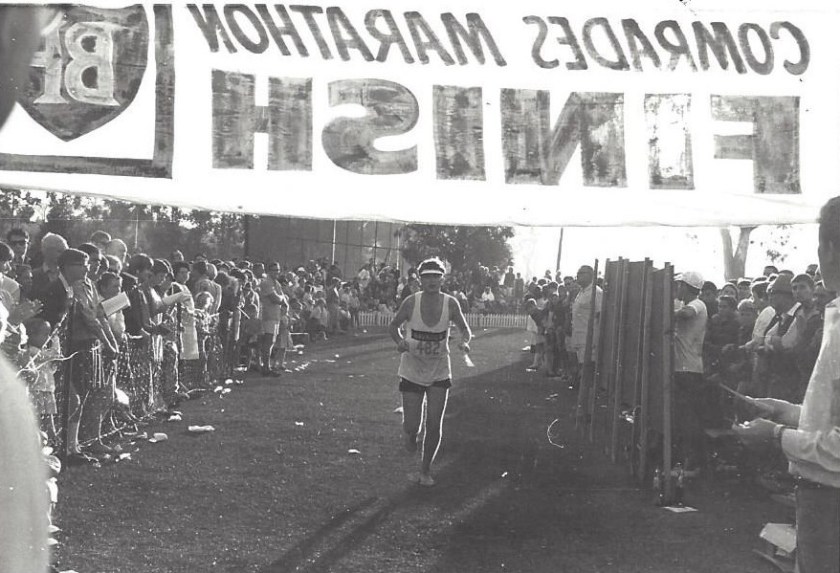
Back to that first Comrades and I remember nothing more until I came into the grounds of Collegians Club where we finished in those days. I don’t remember hearing any announcer and I don’t remember if there was one. Then suddenly it was all over and the watches had stopped at 10:25.  

4:25pm on the 31st of May 1968 and I had finished Comrades!

I was alone on the track. No other runners.  Just me.  We weren’t given our medals on the day as happens now. We had to attend a “Medal Parade” a few weeks later where they were presented to us or they were posted if runners couldn’t get to the Medal Parade.  The medals were engraved with our name and time.

COMRADES FINISH 1968

I did 5 hours and 8 minutes for the first half and 5 hours 17 minutes for the second half.  Still very proud of that split although I still have no idea what the distance of each half was.  I didn’t care and I still don’t! 

I had trained for four and a half months from absolute scratch to get there but I was very strong mentally because I had given lots of attention to that side of things as well as the physical side and the way I went up Polly’s was proof of that.

So the 10th of June 2018 I’ll be 71 and I’ll be attending my 60th Comrades and at the same time celebrating the 50th anniversary of that first run in 1968.  I find it hard to believe that its 50 years ago but it is and so much water has flowed under that bridge since then but there are two things that have stayed in the same place.

Durban and Pietermaritzburg!

The start and finish may have been moved around a bit but Durban and Pietermaritzburg are still where they’ve always been! The distance may have changed a bit over different years but the race is always between those two cities and they’re where they’ve always been! 

I have often been asked what distances I ran in my various Comrades.  I have no idea how far any of them were.  The distance made not one scrap of difference to me nor should it to anyone running Comrades.  I’ve asked a couple of winners if they knew what distance they ran and those I asked also didn’t know. I was told to get to the start before 6am and run to the finish before 5pm as it was in those days – so I did!


I’ve missed only three races since 1956 and those were deliberate misses which I did after being at 50 races in succession and I did so because I thought that I had probably got Comrades out of my system by then. Those three were 2006, 2007 and 2008 and by the time the 2008 race came round I was going crazy because I wasn’t there and I even took myself overseas so that I didn’t feel it but it didn’t help. I sat in front of a computer all day in the UK and watched as much of the race as I could that was streamed live via the internet so whilst I regard myself as not having been there, I certainly watched as much of it as I could from 10,000kms away!

I didn’t plan that the two anniversaries (attending my 60th and the 50th anniversary of my first run) would both fall in 2018 and it was only a few years ago that I realised that they do.

Anyway I hadn’t got it out of my system after the 50 years and 2009 I was back at Comrades and have been every year since and as long as I am able to do so will continue attending.  My next target is the 2021 Comrades. 100 years since the first Comrades when Bill Rowan trotted into Durban to win in 8 hours 59 minutes. That’s only 3 years away so all being well I should make that!

My next target after that is 2025. The 100th race.  I was privileged to have run the 50th one and to have notched up my personal best time so to be at the 100th whilst only as a spectator is an important goal. 

COMRADES 1975

I have been involved in many facets of Comrades. I started as a spectator and then a second in the days before refreshment stations when runners had their own personal seconds. I’ve also served on the Comrades organising committee in what was one of the most rewarding of experiences.

BARRY VARTY GREEN NUMBERI spent 18 years on the road reporting on the race “live” into news and sports bulletins for 702 Talk Radio and for many of those same years on arrival at the finish juggled my phone and a microphone as I also handled the stadium announcing as part of that team. It was also during that time that I was asked to handle the prizegiving one year and had the honour of meeting Madiba.  Something I will never forget.

IMG_20160306_100853I brought many great runners home from that announcers’ tower at the finish and if you were to ask me to single out one or two special moments I would have to say the day in 1989 when Frith van der Merwe ran 5:54 to finish 15th overall and set a woman’s time that I think is going to take a huge effort to beat and Bruce Fordyce’s 9th win in 1990.

I doubt that we’ll ever see 9 wins from a runner again, certainly not in what’s left of my lifetime.  I’m not certain that people fully understand what a feat it is to win Comrades once let alone 9 of them. Ask all those great runners who have failed to win whilst trying to do so and there is a long list I could rattle off of really top class distance runners who tried to win but couldn’t.

I’ve often been asked what the attraction of Comrades is that has drawn me back over and over for 60 years and I really don’t know what it is.  I can easily explain the years when I ran.  I can also easily explain the years when I was working as a journalist or stadium announcer but there are many who would say that the remaining years defy logic and I would be hard pressed to argue that. In fact I would have a bit of a problem arguing why I travel to Durban year after year to attend Comrades as a spectator.

Why I sit at the side of the road on race day cheering on a bunch of runners, most of whom I don’t know and those I do know are so busy fighting their enemy “time” that they don’t want to stop and talk anyway.

I don’t know why I go year after year to Expo to look at the same exhibitors offering almost the same things and why I shake my head along with some of the other “old timers” when we see obvious novices desperate to make sure they finish, prepared to try any product on offer that they think will get them to the finish on race day when all they really need to do is to get out there and run to the finish.

I can’t answer any of those questions and I wouldn’t even attempt to do so. It is one of those mysterious things that one is simply not able to answer.  One of those things that one can try to arrive at some sort of logical answer and still not find one, so long ago I realised that there is no point in trying and that I should simply accept that when I stood at the side of the road as a 9 year old boy in 1956 and watched Comrades for the first time that something magical happened.

There’s no debate that over those 60 years I have met some of the most amazing people, some of whom have become lifelong friends but there’s more to it than just that.  There was something so much more that did so much to shape my destiny and the direction of my life in so many wonderful ways.

That being the case, why try to find an explanation?

February 2018

CAMILLE HERRON

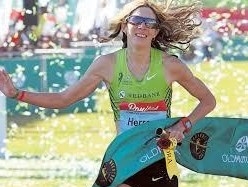
The name Camille Herron wasn’t all that well known in South African Comrades Marathon or road running circles before Comrades 2017 but it certainly is now.  Comrades day 2017 and the American runner led the women’s race from start to finish to come home in 6:27 and to become only the third American winner of Comrades in the history of the race.

It’s not only her performance on Comrades day that has brought her to the attention of South African runners but also what she has done since then with many shaking their heads in disbelief that anyone can do what she has done in so short a period.

No sooner had she won Comrades and she was back in action again when most Comrades runners were still in recovery time but let’s hear it from the lady herself.  I contacted her and she was more than happy to “chat” about her remarkable achievements in just seven months.

DJ:      2017 has been an amazing year for you with a couple of world records, a couple of US records and of course the Comrades Marathon title under your belt and I don’t think there can be too many people who can claim to have done that in the same year – in fact in the second half of the same year but what for you has been the highlight of your year?

CH:     Nothing I have done so far or could do in the future can top the thrill and honour of winning Comrades! It’s the ultimate race to win- to become only the 3rd American win it makes me feel very grateful and humbled by what my body can do! I actually had a hard time getting motivated to train again after Comrades—what do you do after reaching your #1 life goal?! I had to start writing down the rest of my goals. What’s followed since then is the realization that there is more to achieve beyond winning Comrades, although nothing can quite match it.


DJ:      Comrades has been a long term plan for you and in you said somewhere that started thinking about Comrades as long ago as 1995. Tell me how that all started for you and how sitting far away in the United States you came to learn about this race over almost 90km in South Africa?

CH:     Yes, I’m very fortunate that my first running book my Dad got me in Jr. High (1995) was Lore of Running by Timothy Noakes. My young brain couldn’t fully comprehend all the science in the book, but I loved reading the stories about the Comrades Marathon and the heroes of the race like Bruce Fordyce and Arthur Newton. It was hard for me to wrap my head around running that far. It was the only ultra I had heard of until recently. I knew I wanted to run it some day, but I couldn’t have imagined I’d have the talent to win it!


DJ:      The Two Oceans also featured somewhere in your introduction to South Africa.  Was that before your first visit to Comrades and how did that come about and has that been successful?

CH:     I first heard about Two Oceans from the elite coordinator for the NYC Marathon, David Monti, back in 2011. I had been racing back-to-back marathons with short recovery time between the races. He planted the seed for me to consider stepping up to ultras and look at Two Oceans. It ended up being my first ultra in 2013. I under-performed a bit by finishing 10th (moved up in place because of a Russian caught doping). I didn’t know how hard to push myself stepping up in distance. Everyone was talking about Comrades while I was over there, so I first tried it in 2014.


DJ:      You had a couple of visits to Comrades before it eventually all came together for you with the 2017 race and without any competition to worry about you seemed to have a fairly comfortable race from start to finish.  Was it a comfortable race or did it just look that way?

CH:     When I stepped it up to 100K in 2015, I was in a league of my own when I won the World title in 7:08 and came back 6 weeks later to break Ann Trason’s World Record for 50 miles on a hilly course in the rain/wind (5:38). I wanted to come back to Comrades and give the Course Records a shot. However, since then I’ve had some freak accidents tearing both hammies. Then in mid-March I accidentally tore my MCL at a trail race. I thought my dream was dashed once again! I had to take 2 weeks off and then had 8 weeks to train for Comrades- we made every day count.

I got back to 80% health and fitness. Judging by the heart-rate based pace (80% of HR max) I was going at 2 weeks before the race I knew I had a shot to contend for the win. I was very confident I could focus on this effort, run my own race, and be up front. I ran within myself on the first major climb and was anticipating trying to drop the pace once the course flattened after 40K. Between the exceptional heat and my hammy getting tight it made it tough to increase the pace to go after the course record. Having a large gap, I knew I could take my time at the aid stations to rehydrate (including enjoying some beer!). I continued to focus on pushing at 80% effort. I never felt exceptionally fatigued- it was mainly my tight hammy that weighed on my mind. Once I crested the Polly Shortt’s Hill, I knew I was going to win! It was exciting!!!

Crossing the line to win Comrades 2017

DJ:      Getting back to what you’ve done since Comrades.  What you have done is something that is pretty much unknown to the average Comrades or South African runner.

Four weeks after Comrades it was the Western States 100 and whilst that didn’t go according to plan you were still there.  Then a few months later and you were back and you broke the Women’s world 100 mile record at the Tunnel Hill 100 miler finishing ahead of all the men in that race and you took over an hour off the previous women’s world record.

Then another month later we find you in Arizona for Desert Solstice at the beginning of December and there on a 400 metre track you broke the US 50 mile record, the world 12 hour track record and the US 100km track record at the same event. 

That is an amazing performance. How much did that take out of you?

CH:     For me and probably most South Africans the year sort of revolves around Comrades as the ultimate goal! However, there are more races and goals to go after the rest of the year! I have to credit Ann Trason and many others who showed the way and pushed the limits of how quickly we can recover and how far and fast we can go. She won Comrade and Western States twice in the same yr. I had already pushed my own limits this way as a marathoner. To be doing it now in ultras is a fun test! Comrades is still a far ways off right now, so I still have a lot of time to re-focus on building towards it again. I’m well-trained and I don’t think the longer races take as much out of me as the shorter, faster races that ~tear up your muscles. It also gets easier to recover the more you race. I haven’t felt as beat up after Desert Solstice as I felt after the Tunnel Hill 100. I certainly won’t race this much or as extreme leading up to Comrades! I think the longer races and trail races build physical and mental strength. I can progress towards speed and being more recovered leading up to June.


DJ:      As you know I follow you on Twitter and after the Desert Solstice was all over you tweeted that after you broke the 100km record you felt a “bear on your back” and had to force yourself to go on for the 12 hour world record but you did.  Where did that strength come from?

CH:     For Desert Solstice I have to credit my husband for giving me a pep talk to get back out there! I have a strong mental will to reach my goals—getting that long-standing 12 hr World Record held by Ann Trason was something I felt I had to do. Once I got going again I was on a mission! I get mental strength from my training and thinking about all the things I’ve overcome as a runner and in life. Even watching the TV coverage of Comrades and hearing the commentators doubt that I could keep it up leading from the start, there was never a doubt in my mind that I was going to win. I was very confident in the effort I was giving and knowing what I’m capable of—this self belief holds true for any race. Being able to persevere and push through the low points has always been something I’m good at. Both of my parents were great athletes. I believe I got it from them to stay calm and composed under pressure, being both a basketball player and stage performance (dance, piano, band). I used to push myself at basketball in extreme heat until I’d black out- hearing stories from Dad this is what I thought I had to do to get better! I’d eat something and then come back out to play. It’s the culmination of these life experiences that helps me mentally and physically break through, stay positive, and continue to find mental inspiration.

DJ:      Are you not concerned that you are perhaps doing too much and that you are asking too much of your body and yourself?

CH:     I’ve had enough serious injuries to know that tomorrow isn’t guaranteed! I have to make it happen now while I still have my health and speed to do it. I’ve had a very long career already as a prolific marathoner and racer to know my limits and also how to recover quickly. I’m healthier when I’m training and racing consistently. I’m 35 now and I only have a small window to continue to chase the ultra speed records. I’m actually not racing as much as I used to (even if it appears I am racing a lot!). I’m focusing now on being at my best and more rested for the bigger and brighter goals like winning Comrades and continuing to break World Records. People like Ann Trason show us you can pursue even more epic feats, like winning Comrades and Western States in the same year.


DJ:      We know you’re coming back to Comrades 2018 and you’ve hinted that you are looking at the record and if that happens you would be only the fourth woman to go under 6 hours on the Down Run.  What are your plans between now and the 10th of June 2018 – Comrades day?

Will you be doing any more racing before then or will you be concentrating on building up to Comrades and at the same time recovering from a very tough second half of 2017?

CH:     I’m really feeling great right now and want to continue to keep the momentum going. Staying healthy is our #1 priority, so I work diligently with my healthcare team! I’d love to give the 24 hr World Record a shot this winter. I also need to qualify for Western States at a trail race. Otherwise in April-June I will be focused on preparing for Comrades and being sharp and rested to go after the win and course record. Ann Trason is one of the few women to have broken 6 hrs, so to be surpassing her records from 50-100 miles gives me the confidence I can do it!


DJ:      Finally. Tell me about the beer. Everybody asks about the beer you drink whilst you are running and I think you had two during Comrades and I have had people saying to me that perhaps they should try it.  Does it help you or is it just a refreshing drink on the road because you enjoy it?

CH:     When you’re running a gruelling, long race like Comrades I think it helps to have something you enjoy eating or drinking at some point later in the race! I figured out the beer thing by accident at a trail race over a yr ago—it helped me overcome a bonking point in the race. We now have incorporated it into part of my race plan—at least for me it helps settle my stomach and give some mental clarity (in moderation of course!). I look forward to it every time. I enjoyed Jack Black’s Brewers Lager at Comrades.


Perhaps you now know a little more about the lady who won Comrades 2017 and since she and I had this little “chat” she has made her intentions for 2018 clear and over the first weekend of the year she won the Bandera 100km and Trail Run in Texas, one of the toughest trail runs and one of the oldest.

Camille we look forward to seeing you back in June!


January 2018

CHERYL WINN – A UNIQUE COMRADES ACHIEVEMENT

I’ve known Cheryl Winn a very long time and I’m honoured to know the person who has achieved what no other person in Comrades history has achieved.

Cheryl was elected as Comrades Marathon Association Chairperson at the AGM on the 21st of November and with that happening has become the only person ever to have won the race and then gone on to become the Chairperson of either the organising committee of the race as it was in days gone by or Chairperson of the Board of the CMA as it is now.

That, I’m sure you’ll agree, is an amazing achievement.

cheryl winn head & shoulders

I first met Cheryl in 1982 when she was on the Committee of what was then TRRA (Transvaal Road Running Assoc) and she and I went along together to speak to Chris Gibbons at Radio 702 about the establishment of a road running diary on radio once a week on Radio 702 where runners could go for the latest information on a Friday morning on what was going to be happening that weekend in and around the Johannesburg area.

DJ:      Cheryl, that was 702’s introduction to road running and my introduction to radio that neither 702 nor I knew would last something like 25 years with 702 becoming a major player in the road running world in South Africa and a very big thank you for the role you played in that and very few people know that you were involved in that and I’m not even certain you know just how big a role you played in bringing that about.

CW:    It does seem like a hundred years ago and brings back so many fond memories.  Running changed the entire course of my life, introduced me to my husband, numerous lifelong friends, interests and experiences across boundaries I might otherwise never have ventured to cross.  For me it has at all times been a labour of love and I can only profess that my involvement in athletics has given me so much more than I could ever return in two lifetimes. I sincerely regard this latest development at Comrades, not as an achievement, but a humble responsibility I have been entrusted with by my colleagues to lead softly, contribute and pass on the knowledge and experience I have accumulated over many years.


DJ:      Fantastic, but let’s go way back and where for you, did your relationship with road running start?  By the time you and I met – and that’s over 35 years ago now – you had already won Comrades in 1982 in what was – I think – the longest Comrades in history and you had two second places in the two years before that but when did you start running?

Did your running start in this country or before you left the United States, your home country and how did it start and at what age and distances?

CW:    In the early 1970’s while at university in the USA, I used to jog with my girlfriends around the campus lake, but that was mainly because the female residences were on one side of the lake and the guys’ residences on the other.  I can’t really say that it was in any manner related to serious athletic endeavour.

Some seven years later, after having married, moved to South Africa and given birth to two sons, I began regular jogging and then running in about in 1977 under the influence of a good family friend Dr Ivan Cohen (who later founded Run/Walk for Life).  I soon hooked up with a loose group of (exclusively male) runners affiliated to Pirates, Wits, Varsity Kudus and Rocky Road Runners, all of whom were focused on one specific goal  – the Comrades Marathon – which for me began a love affair with the race.  At that stage I didn’t know a single other woman runner.


DJ:      I can understand the love affair with Comrades – it’s happened to many of us, and certainly to me – but how many did you end up running in total?

CW:    I completed 6 Comrades between the years 1978 and 1984.  1 bronze & 5 silver medals.

1978 4th 9:09

1979 DNF

1980 2nd

1981 2nd

1982 1st

1983 4th

1984 5th


DJ:      And when was the realisation that you had the ability to win this thing?

CW:    After finishing my 1st Comrades (1978) in 9:09 on relatively little and extremely unscientific training, the so-called “gurus” in my running group convinced me I could break 7:30, which was unheard of for a woman at the time.  I began training in earnest for the 1979 Comrades Up Run, with the goal of winning and becoming the first woman to earn a silver medal.

Unfortunately I got side-tracked along the way, running and racing at just about every opportunity.  I suppose it was inevitable that I soon picked up a serious achilles tendon injury while running the Boston Marathon.  I eventually started the 1979 Comrades Up Run, but was forced to withdraw at the first opportunity to catch a lift with my second which was at Hillcrest, less than 30km into the race.    

The following year 1980, I achieved my goal of earning a silver medal in a time 0f 7:22, unfortunately 3 minutes behind a young student from Cape Town named Isavel Roche-Kelly who became the first woman in history to break 7:30.  The next year Isavel and I finished in the same order, still the only two women to earn silver, and in 1982 which was the longest race ever, I finally won.  I suppose an interesting trivial statistic is that I earned the 2nd, 4th & 5th silver medals awarded to women.

CHERYL WINNING

DJ:      Do you think it was as difficult back in your running days to fit in all your jobs of being Mom, wife, runner and Comrades winner because you hear a lot of women runners complaining today that they don’t have time.  Do you think things have become tougher for the modern runner, particularly the women runners in 2017 than it was in 1982?

CW:    I think that just about every aspect of life has become complicated and more hectic than it was 30 years ago.  Of course, it was a bit of a juggle at the time, being a mom to two young boys, a wife, and a competitive runner, as well as holding down a full-time job with NIKE and already serving on my club committee and Transvaal Road Running.  But I do think that in general life proceeded at a much slower pace back then. We were young, energetic, and we got on with it.  On the other hand, it has always been my experience that if you want something done, ask a busy person to do it.

CHERYL GETS TROPHY


DJ:      After your win, was that it?  Did you then retire from active participation in road running and racing and if so what caused that?

CW:    No. After winning in 1982, I did carry on running competitively for a further 3 years, during which time I simultaneously became progressively more and more involved in athletics administration.  In 1986 I gave birth to my 3rd son and the original intention was to return to competitive running, but it just never happened.  By then I was employed fulltime as general secretary of the SA Road Running Association, which required a lot of travelling, I had two strapping teenagers, and a baby and something had to give.  Family commitments obviously came first, so it became an easy decision to relinquish the stress of competition and serious training in favour of the joy and satisfaction I received through my job with SARRA in being part of enabling others to achieve.


DJ:      You’ve been involved in admin of road running a very long time.  What drew you to that?

CW:    I suppose it was just another type of challenge, which I found more rewarding because it was less self-focussed.  I enjoyed being part of a vibrant community of passionate, hard-working, dedicated people motivated and inspired by the achievements of others.  I have grown so much as a person through the relationships I have made through running.  It has been both a humbling and exhilarating journey to witness some phenomenal individual  athletic achievements, watch the sport of distance running develop and prosper, participate in the staging of  world class events – numerous SA Championships, the Johannesburg & Soweto Marathons, and of course the greatest of them all – Comrades.  Most of all during my time with SARRA and later ASA, as well as with Comrades, wherever I have travelled I have met the most amazing heroes at grassroots level giving their time and energy to the sport. 


DJ:      That said, it must be extremely frustrating at times with all the changes you’ve seen and been through over the years. You’ve seen bodies like TRRA (the Transvaal Road Running Assoc) and SARRA (the South African Road Running Association) go and these were bodies that did a huge amount for road running and there must be times when you’ve wanted to throw in the towel but you didn’t and you’re still there.

Is this a case of you’d rather be on the inside looking out where you can do more than you can on the outside looking in where you perhaps can’t?  If that is the case it must take enormous passion and drive.  What keeps you going?

CW:    I have always been a great believer and dedicated disciple of transformation in sport, so the answer is no, I have never experienced bitterness or regret that the old bodies had to be sacrificed to the cause of unity.  There might have been just a little frustration at times, equally directed at both old and new orders – those who needlessly and selfishly resisted change, as well as those who exploited it for their own misguided purposes.  I believe the not-so-secret ingredients of true leadership are humility, empathy, trust and respect and there are no shortcuts to true transformation – it demands integrity and sacrifice.


DJ:      Have you had a break during the time I’ve known you in 1982 or have you been involved every year in the admin side of things since you started?

CW:    The only real break I have had in athletics administration since first serving as Pirates Road Runners Secretary, then Chairperson in the late 1970’s, through involvement in Transvaal Road Running, then South African Road Running, Comrades Marathon and Athletics South Africa was a period between 2007 – 2013.  In 2013 CMA experienced some transformational challenges and I was persuaded to come back.


DJ:      I know you’ve been involved in many different aspects of the admin side of things from the secretarial to media to where you are now as newly appointed Chair of Comrades.  What has given you the most satisfaction to date, excluding the Chairperson position which is brand new.

CW:    First and foremost, it has been the lifelong friendships and the collaborative, incredible, mutually respectful and collegial relationships I have experienced at all levels.  I have been blessed to have worked with literally hundreds of passionate, selfless, diligent, presidents, chairmen, secretaries, administrators, organisers, officials, coaches and enthusiastic volunteers all over South Africa and it has enriched my life and my personal character immensely. 

The second most satisfaction I have experienced is to have borne personal witness to some of the most outstanding and record-breaking athletic achievements, such as:

1984 – to have witnessed Ernest Seleke becoming the first South African to break the 2:10 barrier for the marathon in Port Elizabeth in 2:09:41.

1986 – just two years later to have witnessed Zithulele Sinqe and Willie Mtolo shatter Seleke’s record running 2:08:04 and 2:08:10 respectively (also in Port Elizabeth) which at the time placed them in the top 10 all-time fastest marathons in the world.

1987 – the SA half marathon championships in East London in my mind goes down as one of the greatest achievements in South African sporting history when Matthews Temane pipped Zithulele Sinqe by 1 meter to shatter the world half marathon record in a time of 60:11, with Sinqe credited with the same time.  Being there that day was the most electric sporting experience of my life.

Over the years there have been numerous other outstanding performances I have witnessed – such as Frith van der Merwe’s phenomenal Comrades 5:54:43 in 1989, Elana Meyer’s 46:57 15km African record in Cape Town 1991, Sam Tshabalala beating my good friend Willie Mtolo to become the first black winner of the Comrades Marathon also in 1989 and watching my other good friend from my earliest days of running, Bruce Fordyce, claim his 9th Comrades title.  

And then, there are the ordinary runners – to this day, I never get through a whole Comrades Marathon day without being moved to tears by their sheer bravery, determination, passion, perseverance, joy and how much the race means to them.


DJ:      And the most stress?

CW:    To be honest, it is in my nature to strive to focus on the positive, but if I have to give an answer as to most stress I would have to say definitely the effects, the consequences and to this day the legacy of apartheid.

It broke my heart at the time to see athletes of the calibre of Temane, Sinqe, Mtolo, Xolile Yawa and others denied the international acclaim and recognition they rightfully deserved.  It still breaks my heart that there is talent out there that goes undiscovered, while some of us bicker over the design of a t-shirt. 

It breaks my heart that our modern-day Comrades winners do not enjoy the recognition and associated benefits that Comrades winners did 20 and 30 years ago.

And most of all it breaks my heart that a whole “class” of runners may be being left behind because of lack of access to technology.  These are the sort of issues that I dwell on when I can’t sleep at night. These, plus the huge cultural chasms we struggle to breach amid lack of trust, empathy and respect for one another.


DJ:      A bit of a fun question that I have asked many people who used to run “way back” is, If it were possible for you to run just one more Comrades in the modern era as it is now with 18,000 runners, would you like to be able to do so?

CW:    I would certainly love to experience being on the start line, where the atmosphere is electric and the air is full of anticipation and possibility, and the camaraderie out on the road.  However, I’m not so sure I would like to find myself at the bottom of Polly Shortts on an Up Run.  I am too old for this.


DJ:      You have a pretty good knowledge of Comrades.  I have a thing in the men’s race I call my Super Comrades so now would be a good time to have the same thing for the women’s race as it’s been going 42 years.  If it were possible to take all the women winners and line them up together in one Super Comrades who would be your top 5. If I remember correctly I think we’ve now had 25 different women’s winners.  You can put them in any order and you are welcome to include yourself if you wish.

CW:    To my mind there are an obvious top 4 –

  1. Frith van der Merwe
  2. Elena Nurgalieva
  3. Ann Trason
  4. Maria Bak.
  5. is a difficult call. Eleanor Greenwood and Caroline Wostmann both have had amazing one-offs, which they haven’t yet replicated.  I suppose the other half of the twins – Olesya has to fit in there somewhere with 2 wins and 10 top 10 finishes, but I’m going to be patriotic and go with Farwa Mentoor for 10 top 10 finishes in a row between 2002 and 2011, during most of which she also finished as the 1st South African.  During that period she was the only South African who was competitive against the Russians.


DJ:      Interesting that you leave out the third of the only three women to have broken six hours! 

Do you ever get out and do any sort of running these days?  Even the odd parkrun?

CW:    I have had two operations on my left foot and have developed a chronic lung disease, so no I am not able to run at all.  I do however exercise daily – either gym, brisk walking, or both.  Incidentally, I don’t think enough credit has gone to Bruce Fordyce for his introduction of the Park Runs which have instigated a 2nd road running boom in this country.


DJ:      I certainly agree with that comment about Bruce.

Finally, how much longer are we going to see you involved in Comrades or are you getting close to calling it a day after your term in the chair is up – or do you have more that you still have to offer after that?

CW:    I really am reaching the end of the road and have faithfully promised my family that this is my last term on the CMA Board, however I would like to remain involved with the CMA Official Charities, which is an aspect which is particularly close to my heart.

IMG_20171123_093512

Our newly elected CMA Chairperson Cheryl Winn, the only person in Comrades history to have won the race and then gone on to hold the position of the chairperson.  She has served this race and road running in South Africa in the most amazing ways over many years.

I think we’ll still see her around for a lot more years – but hey- that’s just my view!


November 2017

COMRADES DOWN RUN ROUTE

I have written this description of the Down Run route as I have seen it after having been done from many years of running the Down Run and also having trained on the course of the Down Run over many years.  The only section which is new to me is the last section from Tollgate to the Moses Mabida Stadium which was run for the first time in 2018.

I have tried to keep the distances as close as possible to official race distances but with ever changing road conditions this is almost impossible but the distances I have shown are very close to the actual official distances and are certainly close enough to enable any reasonably trained runner to complete the race comfortably.

START TO TOP OF POLLY SHORTS (About 5kms)

There’s a change to the way you leave Pietermaritzburg this year and this came about in 2018 and you’ll be reverting to the route that runners in the 60’s used to leave at the start of the Down Run.

From the start at the Pietermaritzburg City Hall it’s along Chief Albert Luthuli Street towards Durban then along Alan Paton Avenue where you run past the university and then contraflow onto the N3 national freeway.  From there, you will glide off right onto the Market Road on ramp and then left onto the slip road to CB Downes Road and then follow the traditional Comrades route towards Polly Shortts and onwards to Durban.

Climb fairly gently from the start out of Pietermaritzburg

DOWN RUN START

DANGERS

In the dark although there are street lights. Everybody around you is fired up with adrenalin and the excitement of finally getting to Comrades.

The race leaders start far too fast and as a result pull the entire field with them starting too fast


TOP OF POLLY SHORTS TO THE BOTTOM OF POLLY’S (About 2kms)

Steep downhill

DANGERS

Usually totally dark and huge numbers of runners. Many removing the black plastic bags they were wearing for warmth at the start (not actually allowed as these have been banned by the organisers) and discarding them in the road. Danger of tripping.

At the bottom of Polly’s there are speed bumps and the danger of tripping.


BOTTOM OF POLLYS TO UMLAAS ROAD (Highest point between Pmb & Dbn) (About 12kms)

Gentle climb of about 1km from bottom of Polly’s to Ashburton Store.

Then down “Little Polly’s” to the “Tumble Inn”. I remember in days gone by it wasn’t unusual to find locals who had dragged a doubled bed out to the edge of the road to cheer the runners from the comfort of their bed whilst sipping champagne but snuggled up in bed.

From Tumble Inn bridge steady climb all the way to Umlaas Road. The worst part the last 1km before crossing under the Highway at the Lion Park turnoff. After the bridge a gentle climb to Umlaas Road.

DANGERS

Still fairly dark over the entire stretch to the bridge under the Highway. This is where you USUALLY cross the first timing mat and get to the first cut off point so it’s also once you have crossed the first timing mat that family and friends can start tracking you from the Comrades app.

Once again the dark and adrenalin of the runners causes running too fast on the climb from Tumble Inn


UMLAAS ROAD TO CAMPERDOWN (About 4kms)

Fairly gentle with a nasty but short hill not long after leaving Umlaas Road as you go under the highway.

The first of the fairly big crowds of spectators at Camperdown. Usually a number of toilets available.

DANGERS

Nothing of any consequence other than the nasty little climb mentioned above.

CAMPERDOWN


CAMPERDOWN TO CATO RIDGE (About 4km)

After leaving Camperdown with a very slight and hardly noticeable climb of about 400m there is a dip and then a short but fairly steep climb to a sharp right turn across the bridge that crosses the N3

After the bridge a gentle run alongside the N3 to Cato Ridge. Through the village under the N3 again and a right turn and in this area is the second cut off point.

DANGERS

Potholes coming into Cato Ridge and not seeing them and stepping into one could badly twist an ankle and there are also a speed bump or two.


CATO RIDGE TO INCHANGA CARAVAN PARK (About 11km)

Climb out of Cato Ridge on a deceptively long although not too steep section. This takes you onto the start of “Harrison Flats” that really is flat until you reach a downhill that takes you to the Inchanga Caravan Park.

DANGERS

Nothing but Harrison Flats is pretty boring and the first time you ask yourself what you’re doing here!  Reassure yourself that you are not that far from Drummond and half way!


INCHANGA CARAVAN PARK TO BOTTOM OF INCHANGA (About 3kms)

A gentle downhill from the caravan park to the bottom of Inchanga. You will recognise the start of Inchanga by a small store on the left of the road with a view of the Valley of 1000 Hills

DANGERS

First bit of tiredness creeping in. Pretending to stop and look at the scenery. Don’t stop to admire the Valley of 1000 Hills! If you travelled the route in the days before the race it hasn’t changed!    And if you haven’t seen it already – here it is so you don’t have to stop to look at it again!

cropped-valley-of-1000-hills


INCHANGA (About 1.5kms)

The first of the really big hills on the Down Run. Two ways to handle the hill. Either get behind a runner of your speed and watch his/her heels whilst they pull you up to the top of Inchanga.

If there is no runner at your speed around you, you can walk 200 paces and run 100 paces and continue on that basis until you reach the top.

DANGERS

Many of the runners around you will be walking aimlessly towards the top. Control your climb up Inchanga and anywhere else you walk and you won’t lose time. It is very easy to be hooked into the aimless walking where runners are together and talking negatively about how stupid they are. In most cases these are the same runners who were carried away in the first 20kms.


TOP OF INCHANGA TO DRUMMOND (About 1.5kms)

Down Inchanga and into Drummond and the official half way lies ahead. Not long after the start of the run down Inchanga you see Drummond. When you reach the bottom of Inchanga the road levels out for a very short while and then you climb up to the official half way.

 halfway-sign

DANGERS

The most dangerous part of running down Inchanga is the desire to go too fast to get to half way.  Remember that you already have a full marathon in your legs and you don’t want to punish them more than is necessary.

Big crowds are usually in Drummond and as the climb to the half way starts, ignore them.  Head down and find a pair of shoes in front of you to study. One of the biggest dangers here is the desire (tiring legs) to soak up the atmosphere and walk or even stop for a while.


DRUMMOND TO THE BOTTOM OF ALVERSTONE (About 3kms)

As you leave Drummond you climb a hill that has no real name although many runners have given it a name that can’t be used in polite company!  It’s nasty. It’s really nasty. There is simply no other way to describe it.  Be careful of it as very few people even talk about it. At the top of that climb is Arthur’s Seat and legend has it that Arthur Newton (5 times winner in the twenties) sits in that seat every year on Comrades Day. Here is your opportunity to stop for about a minute to put some flowers you have picked onto Arthur’s Seat and give him a hearty “Morning Arthur” and legend continues that if you do that Arthur will look after you to the finish.

 arthurs-seat

A short “dip” brings you to the Wall of Honour where runners’ names are erected giving the names and race numbers of Comrades runners both past and present, many of whom have gone to that great ultra-marathon in the sky. Don’t stop to read the names on the Wall of Honour. That is just an excuse to waste time.

WALL OF HONOUR

After the Wall of Honour a flat stretch takes you to the bottom of Alverston Hill.

DANGERS

Without doubt it’s the climb out of Drummond. As I said above – IT’S NASTY. The only other minor danger is spending too much time greeting Arthur or stopping to take in the splendour of the Valley of 1000 Hills. Now is not the time for scenery.


ALVERSTON (About 1km)

Alverston is not actually as bad as people make it out to be.  As you start Alverston, there is a little climb, a slight level and then another little climb to the first corner. After that first right hand turn there’s a steady climb to the top. If it’s too tough to run the whole way do the run and walk to the top. Remember 200 paces run and then 100 paces walk and repeat to the top.

DANGERS

If you take care of that first 200 metres or so the hill is yours. Go at it too hard you are in trouble.


TOP OF ALVERSTON TO BOTTOM OF BOTHA’S HILL (About 5kms)

From the top of Alverston all the way through the village of Botha’s Hill it’s fairly undulating.   Not far after the top of Alverston you will see “Phezulu”, a well-known tourist attraction, on your left. About 1km after that is a little climb – again with no name – that wouldn’t be too bad if you didn’t have about 50kms in your legs. After that it’s a gentle downhill to the bottom of Botha’s Hill.

DANGERS

Nothing except that little climb after Phezulu


BOTHA’S HILL (About 1km)

The next real climb on the Down Run. Not that long but your legs are starting to get tired and you may need to do the “walk & run”.

DANGERS

Nothing other than the hill itself and the pretence that you need to stop and gaze over the Valley of 1000 Hills towards Inanda Dam.  You DON’T need to do that!

 valley-of-1000-hills


DURBAN SIDE OF BOTHA’S HILL (About 2kms)

Fairly steep downhill for about 2kms. Just after the top look out for the pupils from Kearsney College sitting cheering runners. They’re there every year.

DANGERS

Temptation to run too fast down Botha’s can cause trouble further on. In fact too fast down any hill to the finish can generally cause damage to your legs from here on.


BOTTOM OF BOTHA’S HILL TO HILLCREST (About 2kms)

When you get to the bottom of Botha’s Hill you will see some shops on your right and you are on a gentle down road – then you hit it!!!!!       It has no name and has been called many not too pleasant names. Nasty nasty climb into Hillcrest. Not too long though.

bothas-hill-village

DANGERS

That little hill with no name into Hillcrest really is very nasty so be careful of it. It’s probably a walk and run hill.


HILLCREST TO KLOOF (About 6kms)

All the way from Hillcrest to Kloof is fairly easy and gentle and almost all slightly downhill although not really noticeable. As you go through Kloof there are lots and lots of spectators who have been there all day. They cheered the leaders and they’ll cheer you. Enjoy the vibe.

DANGERS

Nothing


KLOOF TO PINETOWN (About 2.5kms)

Kloof behind you and you have 2.5kms down Fields Hill to Pinetown. In the distance you will get your first distant view of Durban and that’s a great encouragement.

DANGERS

You will find runners walking down Fields Hill. Again these are the runners who started too fast. Of course your legs are sore. They are supposed to be. You have done just over 60kms.  Be careful not to run too fast down Field’s Hill. If you looked after the way you started, your legs will be just fine.


 THROUGH PINETOWN (About 3kms)

Bottom of Field’s Hill and you are into Pinetown and all the way to the bottom of Cowies Hill just three little “bumps” to worry about. The first as you come off Field’s Hill over a rail bridge. The second as you climb up a little rise to the “cross roads” in the centre of Pinetown and the third half way along Josiah Gumede Road (previously the Old Main Road) under a subway. Only about 100metres.

DANGERS

Nothing


COWIES HILL (About 2kms)

At the end of Josiah Gumede Road (previously the Old Main Road) you meet Cowies Hill. Another of the big climbs. Nothing much you can do but it’s not much more than 2km long. Walk and run may be needed. At the top of Cowies, a good view over Pinetown. Don’t stop to look at it. Then it’s down the Durban side of Cowies Hill and virtually into Westville. Bottom of Cowies Hill and you have 15kms to go.

Now for the first time you can start using the distance marker boards. Count them down from 15kms to the finish.

DANGERS

Just Cowies but once again protect those legs by not running too fast on the downhill side of the hill.

cowies hill


THE M13 THROUGH WESTVILLE TO 45TH CUTTING (About 7kms)

You are now onto what used to be the main highway to Durban before the “bypass” was built. Just after the shops in Westville, there is a nasty climb (no name) of about nearly 2kms and then after that it is all virtually downhill until you get to 45th Cutting. The climb up 45th Cutting is fairly tough and may need to be “walk and run”

45TH CUTTING

DANGERS

The climb from Westville on the M13 up 45th Cutting.


THE TOP OF 45TH CUTTING TO TOLLGATE (About 3Kms)

The climb to the top of 45th Cutting is tough because your legs are seriously tired now and it’s your head that’s doing all the work from here to get you home.  After you get to the top of 45th Cutting it’s downhill until the highway. A nasty little climb of a couple of hundred metres takes you onto the highway and a gentle downhill until you climb up to go under the Tollgate Bridge. The climb to go under Tollgate Bridge is not long but your legs are tired.

DANGERS

Nothing


TOLLGATE TO MOSES MABIDA STADIUM ( 7Kms)

You follow the N3 under the Tollgate Bridge an then take the new fly-over into David Webster Street (M13 to the M4)  which becomes Bram Fischer Road. From there, you turn left into Samora Machel Road and past the old finish venue at Kingsmead Cricket Stadium then on to until that road becomes Masabalala Yengwa Avenue.

You then run contraflow in Masabalala Yengwa Avenue and cross to the north bound lane at Battery Beach Road. You then take the pathway to the left between the bollards, pass the Virgin Active Gym and turn left into the tunnel before Nino’s and onto the field to the Finish Line at the Moses Mabida Stadium and it’s all over!

MOSES MABIDA

One of the main reasons for the move to the Moses Mabida Stadium was to align with the requirements of the Events Act as per the Safety at Sports and Recreational Events Act 2010.

Total distance of the Down Run Comrades Marathon is 90,184km.  It’s almost exactly the same as the 2018 Down Run that used the Moses Mabida Stadium as the finish for the first time.


December 2019


COMRADES MARATHON. WHAT IS IT? :

What exactly is the Comrades Marathon?  No! I’m not talking about the foot race that Vic Clapham battled against the odds and the authorities to get going in 1921 and at which 34 people eventually lined up and 16 finished on that morning in May 1921.

I’m not talking about the race where a bunch of very fast runners take off from the start once a year to try to get to the finish just short of 90km away in as fast a time as possible.

I’m talking about the real Comrades Marathon.  That special something that has happened for 92 years since 1921 and has attracted thousands of people who come and run either from Durban to Pietermaritzburg or from Pietermaritzburg to Durban depending on the direction the race is being held that particular year.

I’m not only talking about the thousands of people who take part in the challenge the race offers to those who take part in this extraordinary footrace that has been called the “Ultimate Human Race” but those countless thousands who line the route year after year to watch the race so that they can simply say “I watched Comrades again this year” or “I haven’t missed Comrades on TV for the last 20 years” or however long it has been.

In my own case I have been at 59 Comrades Marathons, my first as a boy of 9 at the side of the road in Pinetown for the 1956 race when Gerald Walsh was the winner and there were under 100 runners and with the exception of just three races, I have been at every Comrades since then.  People have long since stopped asking me “Why?” and instead it’s not even a question any longer but instead a statement “I guess you’ll be at Comrades again this year” because they don’t have to ask.  They just know!

Why is it?  It’s a question that I’m not able to answer.  What was it that attracted me to Comrades in 1956 and kept pulling me back year after year until I ran my first one in 1968 and then after I have run my 10 had me going back for more and more and still more as a radio journalist, the stadium announcer and eventually back to where it all started – as a spectator.  Then not satisfied with that I started writing about it in this blog.

I look at the new runners and it makes me extremely pleased to see so many who are taking up the challenge that my beloved strip of tarmac between Durban and Pietermaritzburg has to offer. 

A lot of the older runners will say that it’s a lot easier now that there is a 12 hour time limit but there are still 90 odd kilometres that have to be covered and that is still a long way and the fact that the organisers have given 12 hours now gives more people the chance to do the Ultimate Human Race who might not otherwise have done it and that’s a very good thing I would have thought.

There’s nothing in the rule book after all that says a runner has to use the full 12 hours.  You can still set your own target of whatever time you want and if I were still able to run (which sadly I’m not) I would certainly be doing that and looking to be running the times I was running back then – not that my aged knees would allow it but one can dream can’t one?

When I ran my first one and right now that’s the one I want to talk about, I had 11 hours in which to finish it but whether it was the 11 hour time limit as it was then or whether it had been the 12 hour limit as it is now I don’t think it would really have mattered. 

I wanted that medal and I wanted it so badly. I wanted to add my name to those others whose names were there whether they had been amongst the winners like Newton or Hayward, Ballington, Mekler, and Walsh and I knew I had no chance of being amongst them in terms of the times I could run but that didn’t matter or whether my name would be amongst the others whose names were not as well known but were there, listed as finishers and who would be known to only their families and friends but who would be there as a Comrades finisher, I wanted desperately to be one of them. One of those who would be a hero to me.

That is what so many over the years have wanted and that is what so many still want and what the organisers, by extending the time limit, have given to so many more who might not otherwise have been able to experience this.

So you have 12 hours to make this dream come true of running in the Comrades and becoming a finisher and achieving your own personal goal.  It’s only the top few who are in a race. The rest of us are out there on Comrades day taking part in a glorious “happening” that nobody can fully explain in full no matter how hard we try.

You simply can’t explain to anyone why you would want to spend months preparing to spend a full day travelling on foot over very nearly 90km when you know that you are going to be sore and in fact very sore at the end of it and in return you are going to be presented with a very small medal as a material reward. 

What you can’t explain to a person who has never run Comrades is the reward you get in the way of the massive sense of achievement when you finish Comrades and it’s a feeling that never leaves you and a feeling that nobody can ever take away from you. A feeling that stays with you for the rest of your days.

There are just those of us who run Comrades but there is another group who is equally captivated by “The Ultimate Human Race”

That group who get up when it’s still dark and who go out just to watch the race.  Their skottles at the ready to make breakfast and to enjoy themselves at the side of the road. In my running days I simply couldn’t understand these people and why they would want to do this to watch a bunch of people they don’t know running past. 

Then as the years went by and I became a spectator again, I became one of those “breakfast at the side of the road on Comrades morning” people and it’s wonderful.  It just grabs you and you are drawn into the spirit of it all and you find yourself shouting encouragement at people you have never seen before and might never see again and you look at South Africa and what it’s really all about and you wish that all our politicians could be with you to see it too instead of sitting stirring it up in their plush offices that we have paid for with our hard earned taxes.

I witnessed something I haven’t seen for many years at Comrades this year and that was the mother and father of all traffic jams on the N3.  I had forgotten exactly the impact that Comrades spectators have on traffic.  Three lanes of traffic in the direction towards Pietermaritzburg going nowhere!  At a complete standstill and nobody seemed to be getting upset about it!  After all it was Comrades Day!

There is no doubt that Comrades is something very, very special but there is something missing from the lives of many of the newer runners.  Many have very little knowledge of the history of the race.

Comrades has an amazing history and runners really need to know as much as they can about the race.  I see runners struggling to get that prized Bill Rowan Medal yet many have no idea who Bill Rowan was and why the Bill Rowan Medal is awarded if a runner breaks 9 hours!  These are the sorts of things that complete the pride you might feel in having won that Bill Rowan Medal.  I twice ran a time that would have earned me a Bill Rowan Medal but both before the introduction of the medal.  How I wish I could have had those Bill Rowan medals in my collection knowing that symbolically I could have won the first Comrades on two occasions!  That’s the sort of thing I’m talking about when I say learn about the history of the race.

And that’s just one tiny little piece of it. There’s so much more.

When you are out there on Comrades Day, whether as a runner or as a spectator or one of the many helpers who gives so freely of his or her time you need to be aware that you are part of something that is really very special.

Comrades is not just another road race on the calendar!

July 2017


PIET VORSTER – ALMOST DIDN’T START TO COMRADES CHAMP

Ask me which are the highlight years of my Comrades involvement years and there are many but one of them will be 1979 for a variety of reasons not least of which is that I was on the Comrades organising committee when it was still organised by a sub-committee of Collegians Harriers and made up of just 5 of us and it was also the first time in 30 years that we had a Comrades winner from Pietermaritzburg.  The last time that had happened was when Reg Allison won in 1949.

The interesting thing is that this was in fact the first ever win by a Collegians Harriers runner as the club was originally known as Maritzburg Harriers Athletic Club. During 1950 the club became a sub-section of Collegians Club and only then the name changed to Collegians Harriers so when Reg Allison won Comrades in 1949, Collegians Harriers didn’t actually exist.

Piet Vorster went into the record books as that first Collegians Harrier and many would say against all odds but was that really the case?  Those of us in Collegians Harriers firmly maintain that it wasn’t against the odds. After many years I caught up with Piet and we went back to those far off years when this all happened.

Piet Vorster 20170615_165606

DJ:      Before we get to Comrades 1979, how many had you run before that and how had you gone in those?

PV:     I ran my first one in 1971 whilst still at university in Pretoria and then it was on and off until I got to 1978 and finished in 4th place in the year that Alan Robb ran that brilliant sub 5:30 and I realised then that I should really take Comrades seriously. The year before that though, in 1977 I had finished 24th and that was the first bit of encouragement I had.

In total I ran 14 Comrades over a 24 year period.


DJ:      I’ve seen one author who has written that it took you 7 years to win Comrades.  What did he mean by that because it doesn’t sound like it to me? 

PV:     I have absolutely no idea because until my 24th place in 1977 and my 4th place in 1978 I hadn’t really taken Comrades that seriously and it was only after those two and in particular the 1978 4th place that I realised that I had the potential to win Comrades. So that I took 7 years to win Comrades I don’t know about, unless he’s saying that it was 7 years from the time of my first one to my win, but even that isn’t right because it was 8 years and in my early years of Comrades the thought of gold let alone winning didn’t even cross my mind.


DJ:      That same author also said that your build-up to Comrades in 1979  hadn’t been all that impressive but I remember differently that you had some good pre-Comrades runs and that you had a convincing win in the Arthur Newton 56km at the end of April. 

More importantly I remember that a bunch of us from Collegians Harriers went up to Blythedale Beach for the weekend for the Stanger to Mandini race on the North Coast that was very popular back then and we were sitting around in one of the chalets talking about Comrades and who we thought was going to win and your wife very quietly nodded in your direction and said “there’s this year’s winner of Comrades”. 

Do you remember that and had you already decided that you were going for it that year because after that comment I certainly had no doubt at all who was going to win.


PV:     I don’t remember that weekend and as a result I don’t remember that comment from my wife.

Again I don’t understand the unimpressive build-up to Comrades. I was very happy with my build-up to Comrades and I remember that Arthur Newton win and was very happy with that and in fact very happy with the way all my training had gone until the upset right at the end.


DJ:      If we fast forward to race morning and the upset you mention. It’s widely reported that you almost didn’t start because of a painful Achilles tendon you had picked up a couple of weeks before and you had a jog around the block before the start with no pain and you decided to start.  Is that basically what happened?

PV:     No, but partly correct. It wasn’t actually a jog around the block at the start, but what happened was that about three weeks earlier, a group of us were on what was probably our last long run of about 40Km and I felt the discomfort in the tendon so between then and Comrades I gave it lots of rest but on Comrades morning I still wasn’t sure so I went for a run to test it.

I did a run of about 4km on Field’s Hill where I was staying with my brother who was also my second and I could feel it wasn’t quite right and when I got back to my brother’s house, I said to my brother that I wasn’t going to run. My brother insisted that I should at least start and I could always withdraw if necessary but I had come too far and trained too hard, not to start so I went to the start and from there I lined up and started.


DJ:      So now the race starts and Johnny Halberstadt takes off like a man possessed. What was going through your mind because he went through Drummond in record pace and you were 2nd at that stage.

PV:     I was 5 minutes behind him going up Botha’s and my seconds told me that I was closing the gap on Johnny. I was running comfortably and my plan was to carry on at the pace at which I had trained and that was what I was aiming to do. I knew that if I could maintain the pace I was doing I would be fine. I wasn’t chasing Halberstadt. I was running at the pace at which I had trained and was maintaining that and I was on schedule and the Achilles was forgotten.


DJ:      In the stretch between Cato Ridge and Camperdown you saw Halberstadt for the first time since the start and you were still strong. That must have given you a huge boost.Piet comrades

PV:     It definitely did despite the fact that I had been getting the messages on what he was doing for the previous 10kms but when I actually saw him then I knew that I had got him.


DJ:      I don’t think any of us will forget that TV footage of you looking down at him lying in the grass as you went past him. Did you know it was all over then or were you concerned he would or could come back at you?

PV:     I knew it was all over. I knew he couldn’t come back at me. I was strong and relaxed and running at my own pace and I got nothing from my seconds to alert me that I should be worried about anything. Polly’s lay ahead of me and I took that without any problem at all.


DJ:      The first Pietermaritzburg man in 30 years to win Comrades and the finish was in Pietermaritzburg and that was home.  I was in the finish pen that year when you came in and I know how I felt but I can’t begin to think what you must have felt like.  Do you still remember it all these years later?

win (1)

PV:     Strangely, I didn’t feel anything different from any other Comrades finish – at that stage – when I crossed the finish line. What I had done only started to sink in some time afterwards and the following day and in the days after that and then I was very grateful that it all worked out for me that day.


DJ:      A win and a record and just two seconds short of becoming the first man to break 5:45 for the Up Run but very little recognition is given to you for your win these days.  Does that disappoint you – even a little bit?

PV:     No – not at all. I got all the recognition I deserved after my win. If you win Comrades you’ve won it and that’s something you live with for the rest of your life and it never leaves you. One thing that struck me as very strange after the race is that some media, both television and some written media, referred to me as a virtual unknown who had won and that after I had finished 4th in Comrades the previous year!

                                  1011981_10155110677350720_7981837090333988621_n

                This photograph taken after the race with 2nd placed Johnny Halberstadt on the left, Piet in the middle and Bruce Fordyce who finished in 3rd place on the right.

DJ:      Clearly someone hadn’t done their homework!  After that win. Did you come back again and give it another full go because we were starting to go into the Fordyce era and even Alan Robb could only manage one more win against him. Did you retire from competitive Comrades running soon after that?  I know you moved to the Cape but did you carry on running Comrades from there or did you call it a day?


PV:     No, I didn’t retire from Comrades. I got two more gold medals in years shortly after that but I didn’t run in 1980 simply through a lack of commitment but I had a 3rd place in the Dusi Canoe Marathon behind the late Graeme Pope-Ellis and second placed Andre Hawarden in 1980.

I also didn’t run in 1981 but then came back in 1982 and had a full go on the Down Run and finished 6th for a gold medal and then 7th in 1983 then after that, it was a case of as and when I felt like it until 1996 and that was my 14th and last one.


The story then of the man who set the record in 1979 of 5:45:02 and beat Johnny Halberstadt who finished 2nd and Bruce Fordyce who was 3rd and the man who was the first Pietermaritzburg winner in 30 years and the man who, on Comrades morning decided not to run because of a slight niggle to his Achilles Tendon until told to at least start by his brother who was also his second and the rest – as they say – is history!

Sadly Piet contracted Motor Neuron Disease a couple of years ago and today is wheelchair bound.  At Comrades 2017 he was a guest of honour and one of the past winners who was presented with his Winner’s Blazer at the prizegiving, something that Comrades introduced a few years ago and Piet made the trip to Pietermaritzburg for the awarding of that blazer.

Piet also was given the job of awarding green numbers to certain of the runners who had won their numbers and as a result had joined the Green Number Club along with Piet and many others of us who have qualified by running Comrades 10 times.

IMG-20170622-WA0000

Research is ongoing into MND and as we are right now there is no cure and the research is obviously very expensive and should there be any readers of this blog who wish to make donations in Piet’s Vorster’s name to assist with this research this can be done by electronic transfer to:

MNDA of SA,

Account Number: 270629130

Standard Bank of SA Ltd

Rondebosch Branch Code: 025009

Ref : Piet Vorster – Comrades Marathon

Swift Code (essential for International Transfers): SBZAZAJJ 02500911.

Please make sure to notify the Secretary by email as they want to know where donations have come from. The email address is mndaofsa@global.co.za and it is very important to them that they know where donations have come from.  Obviously anonymous donations will also be gratefully received but it is important that the reference is shown for all donations.

 MNDA will gratefully accept donations of any amount as this is a question people always ask.  Every little bit counts.


June 2017